

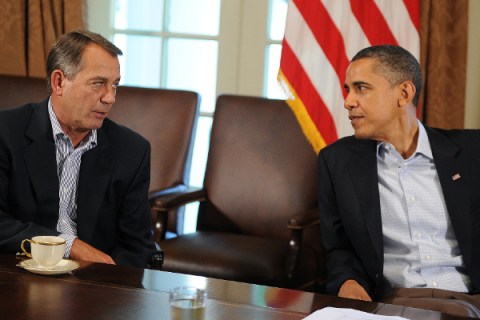
Pew came out with a new poll on Monday confirming what we all already knew: The American people think the last several weeks in Washington have been a disgrace. In fact, the words most often volunteered to the pollsters were “ridiculous,” “disgusting,” and “stupid.” The response was negative from 75% of Republicans, 72% of Democrats and 72% of independents. More than twice as many people have a more negative view of President Obama (38%) because of the debate than a more positive view (18%). Three times as many people have a more negative view of Speaker John Boehner (34%) than a more positive view (11%).
There were, in short, no winners in the last few weeks of debt debate. White House officials pointed to this fact in a briefing with reporters on Sunday night, when they explained why Republicans gave up their demand for another debt limit vote early next year. “The case against it made itself,” an official said. “I think people said, ‘Why on Earth would we want to go through this again?'”
(MORE: Trading Hostages: Why Lobbyists Are Key to the Debt-Limit Deal)
There is also little evidence that Republican and Democratic leaders learned their lessons. There will still be at least two more big Washington showdowns over the next 15 months. They are likely to follow in form, if not substance, the same pattern as the debt debate: lots of phony posturing, theatrical walk-outs, discussion breakdowns, selfish preening, non-factual assertions and, finally, at the last minute, an agreement. In December, Congress will have to cut $1.5 trillion more from 10-year deficit projections, or face draconian cuts to Medicare providers and the military. A year later, in December of 2012, Congress will have to reach a deal on tax reform, or watch all of the George W. Bush tax cuts from 2001 expire, effectively raising rates on millions of middle-class families, a policy which neither party favors.
Can Washington learn from its mistakes? Don’t get your hopes up. We live in an era of micro-markets, where the common good easily gives way to the partisan good, or the talk radio good, or the MSNBC good. And as the Pew numbers show, even though each party did great damage to itself, Republicans tended to blame Obama and Democrats to blame Boehner. This suggests that the lesson for many Americans was to deepen their tribal partisan identities, not to reject them. For example, 29% of Republicans said they had a more favorable view of Republicans in Congress after the ordeal, while only 19% had a less favorable view. Similarly, 28% of Democrats saw their own party more favorably, compared to 11% who felt less favorably. Independents, predictably, rejected both parties and both Obama and Boehner. By a margin of 38% to 13%, independents viewed Obama less favorably. By a margin of 34% to 7%, they viewed Boehner less favorably.
(PHOTOS: Gabby Giffords’ Jubilant Return to Congress)
In other words, leaders of both parties were able to shore up their bases, even as they repulsed the country. Which is a pretty neat summary of national politics these days. Appeal to the base, alienate your opponents, and hope the political center is so turned off it doesn’t even bother coming to the polls.
Of course, President Obama is trying to change this dynamic, because he needs independents and infrequent voters to turn out for him again in the 2012 election. And it is for this reason that Obama may have been the biggest loser of this debate. But being the biggest loser in Washington these days is a bit like being the shortest hobbit.
(MORE: Five Things for Liberals to Like in the Debt Ceiling Deal)