

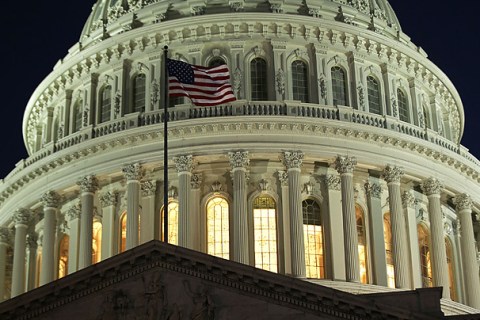
A U.S. flag flies at the Capitol July 30, 2011 on Capitol Hill in Washington, DC.
In the final debt limit compromise, Republicans and Democrats agreed to swap out the hostages. Gone is the threat of defaulting on U.S. bonds by refusing to raise the debt ceiling. In its place: Medicare providers and defense contractors.
If Democrats and Republicans do not agree to another $1.5 trillion in cuts later this year, then automatic cuts of about $500 billion in both national security and Medicare provider spending will be triggered, beginning in 2013. Republicans think the threat of cutting Medicare will force Democrats to bargain, and Democrats hope that the threat of defense cuts will force Republicans to bargain.
But what is really happening is something else: Both Democratic and Republican leaders have realized that they don’t have enough political heft on their own to cut a deal. So they are pointing a gun to the knee caps of corporate lobbyists for the defense contracting and medical provider communities and saying, “Help us, or else.”
Under the agreement, a failure to reach an agreement in December would lead to $50 billion in cuts per year in the “050” national security spending account for the next 10 years. This is a big amount, slightly less than 10 percent of spending on the military and the nuclear arsenal. If this were to happen, the cuts would almost certainly fall disproportionately on military contractors–and especially the builders of boats, planes and troop transport vehicles. (The thought of cutting troop pay, troop benefits or ongoing operations overseas beyond current draw-down plans would likely be too politically radioactive.) “To take that amount of money would have a huge impact,” says Loren Thompson, a military analyst at the Lexington Institute. “You would be forced to look at things that are in production–warships and fighter aircraft.”
So to save their own skin, military contractors, who spent $146 million lobbying Congress in 2010 with more than $16 million in political donations from PACs, will have to get in the game, urging Republicans to find savings in other places. In practice, that will likely mean new revenue, collected by ending corporate tax breaks and eliminating expenditures. If the plan works as Democrats would like, Republicans will be forced to raise taxes with the help of the military industrial complex.
But that is just one half of the lobbying equation. The other half of the trigger would cause a 2% decrease in reimbursements for Medicare providers, pulling about $50 billion a year off their bottom line for a decade. That means lobbyists for hospitals and doctors will also have a dog in this fight. And they are responding. “It’s not over when it’s over,” said Rich Umbdenstock, the president of the American Hospital Association, after the deal was announced Sunday. “Medicare and Medicaid funding for hospital care will be under threat for some time.” Hospitals and nursing homes alone spent more $107 million lobbying Congress in 2010.
Hospitals have already started running ads on cable television protesting the potential cuts, under the banner of a group called The Coalition To Protect America’s Health Care. But simply advocating against cuts will not be enough. Like defense contractors, they are the hostages now, and they must advocate for Democrats and Republicans to come together on a final deal in the fall, before the trigger gets pulled. In the deficit debate, Congress has proved itself inept at fighting for the common interest. In turning the gun on special interests, they are essentially outsourcing that job to Washington’s most effective actors.