In Tuesday’s State of the Union, a Return to First Principles for Obama

  • Share
  • Read Later
Tim Sloan/Getty Images

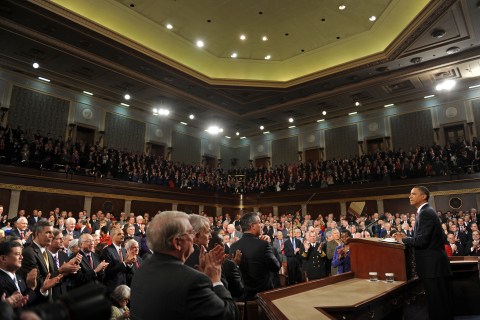
U.S. President Barack Obama delivers his first State of the Union speech to a joint session of the U.S. Congress on Capitol Hill on Jan. 27, 2010, in Washington

Don’t look now, but Barack Obama has a lasting economic doctrine, one that he will present to the American people Tuesday night in the first State of the Union address of his second term. It’s a doctrine, oddly enough, that has been hiding in plain sight all along, disguised by an economic crises that spawned a half-dozen diversions. Remember “Recovery Summer”? Remember “the New Era of Responsibility”? Remember the “car in the ditch”? Remember “the New Foundations for Growth and Prosperity”? You can scratch those. He’s back to first principles.

ZAKARIA: Will Obama Fight or Compromise?)

If you are looking for an urtext to decode Obama’s words Tuesday, you need to go back to 2005, to an unnoticed commencement address at a Division III liberal-arts college in Galesburg, Ill. On June 4, 2005, Obama would lay out the theory of middle-class stagnation in America, a story of globalization and new technology that he believed required a federal response. “In reality,” he warned the graduating seniors of Knox College, “the rules have changed.”

It started with technology and automation that rendered entire occupations obsolete. When was the last time anybody here stood in line for the bank teller instead of going to the ATM, or talked to a switchboard operator? Then it continued when companies like Maytag were able to pick up and move their factories to some underdeveloped country where workers were a lot cheaper than they are in the United States … Not only are those Maytag employees competing with Chinese and Indian and Indonesian and Mexican workers, you are too. Today, accounting firms are e-mailing your tax returns to workers in India who will figure them out and send them back to you as fast as any worker in Illinois or Indiana could.

Before the economic collapse of 2008, the “stimulus” of 2009, the Wall Street reform of 2010, the debt-ceiling nightmare of 2011 and the tax increases of 2013, these were the forces Obama identified as the greatest threats to America’s future: increased competition from overseas and technological change, both of which he said were lowering the earning power of most Americans. At points along the way, as he went from Senator to President, he tried to return to this theme, but it mostly got lost in the static. The economic collapse, and the chaos of responding to it, overwhelmed him and the country. In the public’s eye, he became the President of big stimulus and John Maynard Keynes, the guy who said we need to restart growth by opening the Treasury. The Republicans became the party of less spending, less government and smaller deficits.

(MORE: A Brief History of State of the Union Special Guests)

It was only in the 2012 election cycle that Obama found his footing again. In the most important speech of that cycle, Obama’s remarks on the economy in Osawatomie, Kans., on Dec. 6, 2011, Obama found the refrain that would carry him to re-election. “Long before the recession hit, hard work stopped paying off for too many people,” he said. “Fewer and fewer of the folks who contributed to the success of our economy actually benefited from that success. Those at the very top grew wealthier from their incomes and their investments — wealthier than ever before. But everybody else struggled with costs that were growing and paychecks that weren’t.” Six years later, he was still talking about the same two forces crimping the middle of the country — increased competition from overseas and technological change. He made his campaign an effort to paint Mitt Romney — one of “those at the very top” — and claimed to have a plan to fix the growing economic strain. Romney made his campaign about Obama’s spending record and failure to fully revive the economy. Romney lost.

In recent weeks, Republicans have started to make amends. In the House, Eric Cantor has begun to tell his colleagues that the politics of spending will not be enough to revive the Grand Old Party. “Over the last 20 years, the world has changed,” Cantor said in a major speech last week at AEI. “It used to be that one could make a career out of working for one company. Today, the average worker stays at his or her job for barely four years. Median income in 2010 was about the same as it was in 1997.”

Cantor was trying to turn the page on the old debate of recession and recovery, taxes and spending. He was trying to refocus on the debate on the suffering felt in the U.S. back in 2005, when globalization and new technology were taking their toll on the Maytag plant Obama talked about at Knox college. This is probably good news for the country, and not because it means liberals are winning the argument. Rather, the argument is shifting to more productive terrain. “The traditional dynamic of the two parties is kind of off point,” explains Robert Shapiro, a former economist for Bill Clinton who has informally offered advice to the White House. Under this theory, the key to jump-starting the economy is not just more spending to juice consumption — as many Democrats believe — or more tax cuts and lower deficits to free private enterprise — as many Republicans believe. What Cantor and Obama are getting at is a deeper issue: because of globalization and technology, economic growth no longer means prosperity for the middle class of the country. To borrow a hackneyed phrase, the middle class must first be retooled to take advantage of those gains.

(MORE: A Guide to the Sequester)

At this point, the two men diverge, even though they basically agree. Both believe that something must be done about education, rising health care costs, rising energy costs and the need for more investment in innovation to increase American competitiveness. Both go about it in different ways. They disagree about the structures of their reforms, the price tags and how much government debt should be taken on in the process. But at least they are having the same conversation, for the first time in three years.

Which brings us back to Obama’s State of the Union address tonight. He will lay out his vision for retooling the middle class, growing the economy from the middle out, as he likes to say. This will include “investments” in education, in energy, in infrastructure and in manufacturing. He will dare the Republicans not to stand for his applause lines. (One thing about running a $1 billion presidential campaign: it gives you a lot of confidence that your polling operation understands the American people.) Nothing will change overnight. The next few months will still be ugly in Washington. The disagreements remain real and deep. But the more lasting impact of his speech will likely be in cementing his own ideological vision for the country. He has won the debate he helped start in 2005. Now he just has to see if he can deliver on that victory’s promise.

PHOTOS: Inauguration Day Photo Album — An Inside View of the Pageantry and Parade

154 comments
famulla5
famulla5

All politicians do this and there is nothing new in this speeches The president did what he had to do. He delivered a well-written, well-crafted speech that hit all the right notes and drew the appropriate applause lines. Obama advanced the agenda his has honed over the last four years in office, emphasizing equality, a strong middle class and increased spending. He called for more investment, raising taxes and only modest reform to entitlement programs. In short, he told us that we already know about his vision or America.There were indeed the gestures towards bipartisanship lawmaking and a shift away from the brinksmanship that has paralyzed our system that we heard from Obama on the campaign trail, in his inaugural address and during the fiscal cliff negotiations. But these points fell flat when considering that there has been no genuine desire and willingness to achieve bipartisanship or to call on the Republicans for any bargain that would produce immediate legislative results from the president. Firozali A.Mulla DBA

.

likewhoa420
likewhoa420

@TIME it will be just another night of lies from him.

usalost1
usalost1 like.author.displayName 1 Like

@TIME don,t care what the p o s says.

famulla5
famulla5 like.author.displayName 1 Like

The best or worst yet to come when you read this Moody's Investor Services on Tuesday said downside risks for the globaleconomyhad receded in the past three months, though a number of dangers still remained. In its latest Global Macro Risk Scenarios report, the ratings agency also said it expected economic growth to be slow in many countries. "While our central forecasts are little changed, the downside risks have definitely abated over the past three months," said Colin Ellis, Moody's Senior Vice President for Macro Financial Analysis. "However, we still expect a subdued global recovery with sub-trend growth in most advanced economies over the near term, alongside a relatively soft pace of expansion in emergingmarketsas well." The ratings agency expects real growth for theG20of around 2.9 percent in 2013, followed by 3.3 percent in 2014. It forecast growth in the United States this year, but expected the euro area as a whole to stagnate during 2013. Looks like to date we have no idea where we stand I thank you Firozali A.Mulla DBA

famulla5
famulla5

The World Bank's new chief economist on Tuesday urged Group of 20 finance leaders to better coordinate economic policies in order to prevent a possible global currency war. Kaushik Basu saidG20finance ministers, meeting in Moscow on February 15 and 16, should act on a solution before escalating tensions spark another global economic crisis. While the risk of a sudden plummeting of the globaleconomyhad diminished because of measures adopted in Europe to ease its sovereign debt crisis, a rapid bounce-back in growth was unlikely, he said. "We are not in a currency war but could be inching towards one," said Basu, a former chief economic adviser to the Indian finance ministry. "Global leaders need to coordinate policy to prevent either (one) from happening ormarketsbelieving it is happening. Such coordination is entirely within the realm of the possible; all it needs is determination." He said that, while unconventional monetary policy measures by central banksin the United States,Japanand Europe to revive growth had proved valuable, the impact of those policies was "beginning to feed into the global situation”. “The need is for some global monetary and fiscal policy coordination and theG20is the forum that could push on that, and I think it ought to take that task seriously," he added. Advanced economies have ramped up debt and printed money, which has weakened some of theircurrenciesand made them more competitive. Meanwhile, near-zero rates in the rich world have exacerbated the problem of hot money flows for emergingmarketswith high interest rates and driven up their exchange rates. Not that I know the difference between the TRADE WAR and CURRENCY WAR (TO ME TRADE BRINGS THE CASH) but I would love to have a comment on this. I thank you Firozali A.Mulla DBA           

famulla5
famulla5 like.author.displayName 1 Like

Did you know that the Chamber of Commerce is a union that represents huge corporations and too big to fail Wall St. banks that needed taxpayer money to bail them out? Do you realize this?
Why should common working people be shy on just so some fat cat can take ALL the money? We have little blood but after 1st march this too will be countable red cells I tank you Firozali A.Mulla DBA

famulla5
famulla5 like.author.displayName 1 Like

I have a more to comment about this article to the contributor (namely Mr. Hulbert).  The next time we get a bear market, if you want to buy and hold long stock/call positions and ride them all the way down to a 80% loss or more, be my guest.  I will be happily in long puts and keeping my harvested gains from the current bull market and putting the capital to work in the bear market (buying long puts).  Buy and Hold is depressing and excruciating during a bear market.  I thank you Firozali A.Mulla DBA

famulla5
famulla5

Come 1st March we will have more on the guns economy and the lot. Why we have to wait surprises all when we have the cash liquidity problem now? Stocks closed modestly higher on Tuesday, putting theDowwithin striking distance of an all-time high, as investors looked ahead to President Barack Obama's State of the Union address. Investors will be listening to Obama's speech for any clues on a deal with Republicans to avert automatic spending cuts due to take effect March 1. The tone of the speech will also be scrutinized, with any sign of compromise likely to be warmly received. The S&P 500 has risen for the past six weeks, putting it up 6.5 percent so far this year, while the Dow is about 1 percent away from its all-time closing record of 14,164.53, reached in October 2007. But gains have been harder to come by since the S&P hit a five-year high on February 1. Daily moves have been small and trading volume light as investors search for new reasons to drive stocks higher. About 5.73 billion shares changed hands on the New York Stock Exchange, theNasdaqand NYSE MKT on Tuesday, below the daily average so far this year of about 6.48 billion shares. "We're likely to settle in for a period and digest the gains we've had, though there's still a bias towards positive momentum," said Eric Teal, chief investment officer at First Citizens Bancshares in Raleigh, North Carolina. "Questions over government spending are the big overhang, and we're looking for Obama to inspire some confidence over that tonight." The White House has signalled Obama will urge investment in infrastructure and clean energy, suggesting companies in those sectors may be volatile in Wednesday's session. "Gun makers could also see a reaction if Obama talks about anything with respect to gun control," said Teal, who helps oversee $5 billion. Shares of Smith & Wesson (SWHC.O) fell 2 cents to $9.11 while Sturm Ruger (RGR.N) was up 0.4 percent at $53.91. I thank you Firozali A.Mulla DBA

MHB2012
MHB2012

@ktumulty Analysing a speech before it's given is always conjecture. I sense @michaelscherer still holding on to a bit of "Hope and Change"

michaelscherer
michaelscherer

@MHB2012 tell me after if I got it wrong.

MHB2012
MHB2012 like.author.displayName 1 Like

@michaelscherer If you're saying look to "unnoticed Obama speeches" pre '06 to see how he really feels? I agree vs 08 rhetoric, Tuscon etc.

MHB2012
MHB2012

@michaelscherer So you want me to tell you "after" what you said "before" SOTU speech ...is wrong? Point being what PBO SAYS is meaningless.

reallife
reallife

... and the hive goes on overdrive trying to justify their vote  hahahahaha

as if their help would somehow elevate the status of their "leader" 

The emperor has no clothes...


elcidharth
elcidharth

Hot Topics: Hot Topics_650_Hot Topics_.

February 12, 2013 State of the Union Has Had Little Effect on Obama Approval Has averaged one-percentage-point increase after State of Union addresses by Jeffrey M. Jones

PRINCETON, NJ -- As President Barack Obama prepares to deliver his fourth State of the Union address, a review of Gallup polls finds his approval rating has changed little after each of his first three State of the Union speeches. His approval rating was flat after his first two, and showed a slight, two-percentage-point increase last year.

Gallup has done sufficiently frequent polling before and after State of the Union addresses to measure their impact since Jimmy Carter's presidency. Generally speaking, these addresses have had little effect on how Americans view the president, despite the widespread media coverage of them.

The one-point average increase in Obama's approval rating after his first three State of the Union addresses is consistent with the generally minimal impact Gallup has measured for other recent presidents. For four of the six presidents, including Obama, the State of the Union had its greatest positive impact on their approval rating in their re-election year.

In fact, most presidents have shown an average decrease in approval of one or more points between the last poll conducted before the State of the Union and the first one conducted afterward.

The full data on State of the Union addresses and their effect on approval are shown at the end of the article. Prior to the institution of Gallup Daily tracking in 2008, the results are based on the last Gallup poll conducted before the State of the Union address and the first Gallup poll conducted after it. Often, these polls were conducted several days, if not a week or more, before or after the State of the Union. Thus, it is possible the pre- and post-speech measures for prior presidents were affected by events in addition to the State of the Union.

For example, Gallup measured a six-point increase in George W. Bush's approval rating after his 2005 State of the Union address, but that was given around the time Iraq successfully held democratic elections under U.S. supervision. Also, Bill Clinton's record 10-point increase in approval after the 1998 State of the Union came when allegations of his extramarital affair with White House intern Monica Lewinsky were surfacing. Thus, in both instances, it is not clear how much of the increase was due to the president's State of the Union and how much was due to contemporaneous events.

Implications

President Obama will deliver his 2013 State of the Union address with a 52% approval rating from the American public. His three-day average approval rating has been quite stable in recent days, at 52% in each of the last nine Gallup Daily tracking reports. It is also slightly higher than his approval rating prior to his last three State of the Union addresses.

Given the current stability in Obama's ratings, as well as the historical ratings for most presidents after State of the Union addresses, it is unlikely that Obama's approval rating will change much in the days after Tuesday's State of the Union.

Explore President Obama's approval ratings in depth and compare them with those of past presidents in the Gallup Presidential Job Approval Center.

....and I am Sid Harth@elcidharth.com

jmac
jmac like.author.displayName like.author.displayName like.author.displayName like.author.displayName like.author.displayName 5 Like

 @bobell Rubio is going to state that we need to reduce "big government".   Under Obama "government spending has grown at it's slowest pace since Eisenhower."  Rand Paul is going to hit the deficit.  According to the CBO, "the nation's deficits have shrunk by trillions of dollars, and the debt is close to being stabilized as a percentage of economy."

The bottom line is that we are a much stronger, better nation than the one a Republican handed Obama and the Republican message on the economy and foreign policy hasn't budged since W. came on the scene.    

curticemang
curticemang

.@NMJune @TIMEPolitics. He has principles? Who knew?

NMJune
NMJune

@curticemang My blood boiled at the line "He will dare the Republicans not to stand for his applause lines." @TIMEPolitics

curticemang
curticemang

.@NMJune @TIMEPolitics. It's always about him...always.

Tero
Tero like.author.displayName like.author.displayName like.author.displayName like.author.displayName like.author.displayName 5 Like

@curticemang 

Your conversation is like a scene from Dumb and Dumber or two morons congratulating each other on being morons. Conrats!

jason024
jason024 like.author.displayName 1 Like

@NMJune And this statement is based on....

jmac
jmac like.author.displayName like.author.displayName like.author.displayName like.author.displayName like.author.displayName like.author.displayName like.author.displayName like.author.displayName 8 Like

@NMJune Compared to the last president, his legacy is intact.  Passing the conservative Nixon health care plan and getting the guy who hit us on 9/11,  as he  stabilized the economy that was handed to him is impressive compared to the alternative.  

curticemang
curticemang

.@NMJune @TIMEPolitics. It will take a few years, but his legacy won't look pretty in hindsight.

NMJune
NMJune

@curticemang His entire "presidency" has had one goal — to create his own legacy (as seen in his perverted mind). @TIMEPolitics

stuart_zechman
stuart_zechman like.author.displayName like.author.displayName like.author.displayName 3 Like

@michaelscherer

You write:

"Cantor was trying to turn the page on the old debate of recession and recovery, taxes and spending...This is probably good news for the country, and not because it means liberals are winning the argument. Rather, the argument is shifting to more productive terrain. “The traditional dynamic of the two parties is kind of off point,” explains Robert Shapiro, a former economist for Bill Clinton who has informally offered advice to the White House. Under this theory, the key to jump-starting the economy is not just more spending to juice consumption — as many Democrats believe — or more tax cuts and lower deficits to free private enterprise — as many Republicans believe. What Cantor and Obama are getting at is a deeper issue: because of globalization and technology, economic growth no longer means prosperity for the middle class of the country. To borrow a hackneyed phrase, the middle class must first be retooled to take advantage of those gains."

This passage reads like a press release from the centrist think tank "Third Way,"  Michael Scherer. In fact, this "theory" you describe is an almost textbook definition of the centrist, neoliberal, Third Way ideological framework. It's as ideologically based a political-economic theory as Rand Paul's Libertarian paradise, and yet you have oddly characterized this profoundly ideological view of "globalization and technology" as "more productive terrain," as if acceptance of and belief in this framework were somehow implicitly useful and correct.

What's also inexplicable here is the omission of the ideological terms "centrist" or "neoliberal" or "Third Way" as applied to this "theory" of global reality (in which everyone in establishment DC apparently believes). Given your apparent paraphrasing of Third Way's ideas:

(excerpted from Third Way Report's "The New Rules Economy, A Policy Framework for the 21st Century" February, 2007)

http://content.thirdway.org/publications/57/Third_Way_Report_-_The_New_Rules_Economy_-_A_Policy_Framework_for_the_21st_Century.pdf

"Both sides see change through an ideological prism that pits markets implacably against government. As a consequence, both conservatives and neopopulists [movement liberals] overstate the power of their chosen “side” to rewrite the rules of the economy. And while economic conservatism is premised on the myths of an infallible market and incompetent government, neo-populism is premised on the myths of a failing middle class, a declining America, and omnipotent corporations. 

We urge a different approach, which we call “progressive realism.” Realism means recognizing and understanding the economy’s new rules while accepting the limits of government’s power to stop the forces of change. But as progressives, we also believe that government policies—if modernized and adapted to the rules of the 21st century—can create the optimal conditions for increasing economic growth, expanding middle-class prosperity and protecting those who fall behind.

 As progressive realists, we do not doubt that change is disruptive and, for many people, painful. Globalization has made many jobs obsolete, and both companies and individuals have been hurt by its impact. As the neopopulists note, all is not well with the middle class. 

But we also see the current era of change as one of tremendous opportunity and potential for the middle class. In addition, we view the challenges faced by today’s middle class as very different from the ones that most progressives believe them to be. We perceive the middle class as struggling to get ahead, not—as the neopopulists argue—struggling to get by. Middle-class anxiety does not stem from broad dissatisfaction with capitalism but from the shifting terrain beneath their feet and the increasing irrelevance of an outdated government."

, why would you choose to omit the name for this ideological framework from your piece? Doesn't this theory you've identified comprise the very definition of "Third Way"?

At the very least, Michael Scherer, aren't you concerned with such apparently naked, ideological endorsement as contained in this piece creating the appearance of centrist media bias?

Thanks so much for reading and considering this, @michaelscherer .


TyPollard
TyPollard like.author.displayName like.author.displayName 2 Like

@stuart_zechman @michaelscherer

"Thanks so much for reading and considering this,"


The punch line always cracks me up.

stuart_zechman
stuart_zechman like.author.displayName 1 Like

@TyPollard @stuart_zechman @michaelscherer 

I always mean it. 

I hope to Christ that Scherer reads and considers the idea that the same center-left and center-right economists' consensus that failed to predict and counter the financial product bubble (and even forecast the opposite of what actually happened) are now proposing the same ridiculous "remedies" (for what elites consider to be the nation's economic problems) that they've been peddling at Brookings and PPI for two decades, recession or no recession. 

Truly, I hope that Scherer seriously considers the notion that this centrist consensus (to which he somewhat clandestinely subscribes) is primarily ideologically-based and at odds with observable reality, despite its lofty "pragmatist" rhetoric.

TyPollard
TyPollard like.author.displayName 1 Like

@stuart_zechman @TyPollard @michaelscherer 

I hope so too but am not optimistic. The truth and logic of what you post should have made a dent by now but the bubble is what the bubble is. I appreciate your civility and tenacity. If I had those qualities I would be a better person but instead I cynically laugh so I don't cry.

shepherdwong
shepherdwong like.author.displayName like.author.displayName like.author.displayName 3 Like

@stuart_zechman@michaelscherer “Zen does not confuse spirituality with thinking about God while one is peeling potatoes. Zen spirituality is just to peel the potatoes."

 The whole "change is disruptive" thing is infuriating nonsense, anyway. Buggy whip makers has to learn to do new jobs and so did draftsmen. And "globalism" isn't a much better excuse for elite greed and incompetence either. We profitably make plenty of cars and electronics in this country. Middle class stagnation is about taxes and executive greed. If we progressively taxed and invested in our crumbling physical infrastructure (roads, bridges, sewers, etc.) and built the energy system of the future, and stopped squeezing public service budgets and the pay of lower middle-class workers.The decline of the country traces exactly with the tax cutting mania from Kennedy to George W Bush and the ridiculous payout going to the owners of industry.

stuart_zechman
stuart_zechman like.author.displayName like.author.displayName like.author.displayName 3 Like

@shepherdwong @stuart_zechman @michaelscherer It's infuriating and so obviously crackpot. The idea that we'd be discussing structural unemployment issues --as if that's what somehow resulted from the economic shock of massive, systemic, roaring 1920's financial elite misconduct-- is shameful.

It's ideological lunacy, just as crazy as presuming that a "wave of freedom" would result from US occupation of Iraq, and just as dangerous.

I mean, "the key to jump-starting the economy is not just more spending to juice consumption"?

Really? It's not the federal government borrowing money at historically infinitesimal interest rates, creating massive, country-wide work-project agencies, and then directly hiring US workers at all skill and wage levels (architect, book-keeper, sign-painter, ditch-digger, network engineer, electrician) to build national-scale stuff that everybody needs? That kind of policy hasn't been proven to jump-start the economy after investment banks' financial crashes?

Instead, it's some loopy, ideological "vision for retooling the middle class," i.e. telling folks that the reason they're unemployed is because it's now somehow our fault for all being unemployable all at once?

The problem isn't that people can't buy as much as they used to with falling real wages? Instead it's "the need for more investment in innovation to increase American competitiveness"? We're in for more government "investment,"  not "hiring?" More bank-shot, "market-oriented" nonsense for Obama to brandish in "cementing his own ideological vision for the country"?

It's not only rightist, supply-side tax policy that has put the majority of Americans at the mercy of plutocrats, it's the irrationality of what Scherer describes as Obama's "First Principles" (overlaid with the rhetorical veneer of mild social liberalism) that's also racing us to the bottom.


shepherdwong
shepherdwong like.author.displayName 1 Like

@stuart_zechman@shepherdwong@michaelschererSupply-side tax policy and "government is not the solution" are both products of movement "conservatism" (which is why we've sometimes disagreed about what to call adherents to "Third-way" ideology). The fact that both ideas are so daft, in that they have been so thoroughly disproved over the last hundred years, and yet so mainstreamed in the culture, particularly among our elites, pretty much explains most of our problems. Perhaps, now that the rightists have been discovered to be traitorously insane by the chattering class, they'll take a second look at tried-an-true liberal principles - Econ 101, as Professor Krugman calls it.

grape_crush
grape_crush like.author.displayName like.author.displayName like.author.displayName like.author.displayName like.author.displayName like.author.displayName like.author.displayName like.author.displayName like.author.displayName like.author.displayName like.author.displayName like.author.displayName 12 Like

>  The Republicans became the party of less spending, less government and smaller deficits.

No, that's what their advertising states. When you lift up that rock, you find that isn't quite true.

That the GOP has managed to hoodwink the general population into thinking along those lines is a testament to their decades-long branding and messaging campaign.

> In recent weeks, Republicans have started to make amends.

You mean, 'lip service intended to give the impression that this time they'll be better not like all those other times before.'  Tales "told by [idiots], full of sound and fury, signifying nothing."

I'll believe amends are being made when they're actually pushing workable legislation and engaging in honest negotiation, letting federal appointment candidates get voted on in the Senate, etc.


jmac
jmac like.author.displayName like.author.displayName like.author.displayName like.author.displayName 4 Like

@grape_crush "lip service".   David Brooks today opines that Obama could look to the future by cutting corporate tax rates and installing a "progressive" consumption tax.  As Frank Luntz lip-services through Brooks voice, there's nothing progressive about hitting the middle and lower classes with taxes as conservatives deny that corporations pay fewer  taxes  in the U.S. than in other progressive countries.  The GOP is corrupt at the core and no amount of framing the message actually changes the message. 

bobell
bobell like.author.displayName like.author.displayName like.author.displayName 3 Like

I've got a tax for Brooks -- A tax on financial transactions.  I wonder what he thinks of that one.

PACianci
PACianci

@TIME the middle class has done very well the last for years...

JRubinBlogger
JRubinBlogger

@michaelscherer a failed one but he has one

stuart_zechman
stuart_zechman like.author.displayName like.author.displayName 2 Like

@JRubinBlogger That's basically correct. 

It is a failed vision for America, just as miserable in its outcomes for ordinary Americans as the movement conservative experiment (or the neoconservative's recently failed jihad in the near-East). But because you, on the right, and I, on the left, both can describe that ideological vision as unworkable, this means that the Administration's Goldilocks policies ("the one in the middle is juuuuust right") will be heralded by the centrist media --what you would call "the liberal media"-- as the Very Serious platform. That's how centrist media bias actually operates.

Of course, being a paid rightist, you wouldn't acknowledge the positive results of liberal economic and social policy if they hit you in the face with decades of 20th century middle-class prosperity and social progress,  @JRubinBlogger , so your bleating about Obama's lack of rightism being what "failed" is just as stupidly counter-productive to American discourse as Scherer's centrist bromides.

Thanks for stopping by Swampland, though,  @JRubinBlogger

TyPollard
TyPollard like.author.displayName like.author.displayName like.author.displayName like.author.displayName like.author.displayName 5 Like

@JRubinBlogger 

I'm still pretty sure Mitt Romney will beat Obama. How could he not?

sacredh
sacredh like.author.displayName like.author.displayName like.author.displayName like.author.displayName like.author.displayName like.author.displayName like.author.displayName like.author.displayName like.author.displayName like.author.displayName like.author.displayName 11 Like

"The Republicans became the party of less spending, less government and smaller deficits."

Only when they're out of office. That's just republicans in campaign mode. Once they get in they spend like drunken sailors on shore leave.

bobell
bobell like.author.displayName like.author.displayName like.author.displayName like.author.displayName like.author.displayName like.author.displayName 6 Like

@sacredh Okay, who yanked my comment of three hours ago quoting the same sentence and pointing out that they're also the party of less employment and less growth?  Surely it wasn't pulled just because I accused the Republicans of peddling "bullsh1t" and spelled the word properly.  I mean, we're all grownups here, aside from paule, Kevin, Rusty, amd their crowd.  Right?

AfGuy
AfGuy like.author.displayName like.author.displayName like.author.displayName 3 Like

@bobell 

Don't mention the previous Vice President... at least by first name.  It's a sure ticket to "moderation" Purgatory.

AfGuy
AfGuy like.author.displayName 1 Like

@bobell Or that other name... the one that is both a name and a crude noun.

sacredh
sacredh like.author.displayName 1 Like

I tested DISQUS and found out what I could and couldn't get away with. It was fairly easy. I've posted some things on Fried just to test it and had to go back and delete them myself because of poor taste (hard to believe). Other things have vanished that I couldn't figure out why.

sacredh
sacredh like.author.displayName like.author.displayName 2 Like

I've had a couple disappear (OK, hundreds) for having swear words in them. They show up and then make the magical journey to the land of the lost. Friedlive doesn't seem to have much rhyme or reason to it.