


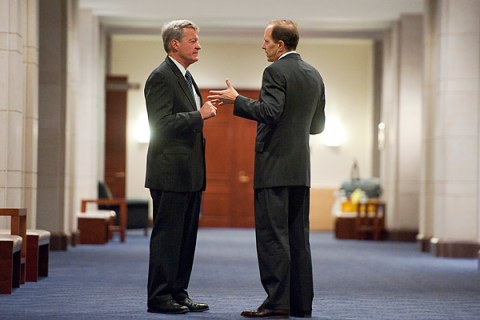
Senator Max Baucus, left, and Representative Dave Camp talk before a House-Senate conference-committee hearing on the payroll-tax cut in Washington on Feb. 7, 2012
Congressional leaders have struck a $150 billion deal that would extend the payroll-tax cut for the remainder of the year, prolong unemployment benefits and adjust reimbursement rates for Medicare. The agreement, announced early Thursday by Senate Finance Committee chairman Max Baucus (Democrat from Montana) and House Ways and Means chair Dave Camp (Republican from Michigan), marks an increasingly rare event in Washington: a directly negotiated pact between Senate Democrats and House Republicans built behind closed doors on good-faith efforts, swapped concessions, very little drama and not, it would appear, a last-minute public crisis.
The sheer viscosity of legislative action on Capitol Hill in the past year has been something to behold. Every measure of weight went through multiple votes in both chambers of Congress, and a few even required high-stakes White House summits worthy of a West Wing season finale. The FAA was shut down for weeks, furloughing thousands of employees, because of a parochial argument about subsidies to 13 rural airports. A similar fate almost befell the entire federal government more than once. The debt-ceiling standoff last summer brought Congress within days of potentially bringing down the global economy, and when it came time to pass minor measures to facilitate the recovery through 2012 — an extension of a payroll-tax holiday and unemployment benefits — negotiations produced just a two-month Band-Aid.
(MORE: House GOP Makes Rare Unconditional Offer on Payroll-Tax-Cut Extension)
But with two weeks left before that temporary fix is set to expire, Congress is poised to vote on the more concrete package announced by Baucus and Camp. The first signs of compromise were evident earlier this week, when the House Republican leadership signaled its willingness to pass the payroll-tax cut without finding corresponding budget savings to pay for it. It was a major reversal, so out of step with the past year of hardnosed negotiating that Democrats feared it might be a ploy to decouple the issue from an extension of unemployment benefits, a high priority for liberals that is not as universally popular as a tax cut. But that wasn’t the case, and Democrats have responded in kind. The joblessness-insurance package has been reworked to reduce the duration of payouts from 99 weeks to 73 weeks in high-unemployment states. Some of the money would come from a $5 billion cut to a fund promoting preventive health in Obama’s health-reform law and increased contributions to pensions for new federal employees, both concessions for Democrats.
The package could see a vote as soon as Friday, and while its approval depends on majority support in the House, where the conservative bloc has not been easily steered, it appears likely to get pushed through by a broad coalition. “This is good for the country. It’s very good for the country. We have an agreement,” Baucus told reporters in the wee hours of Thursday morning. For workers making $50,000 a year who will see an extra $1,000 in their paychecks, it certainly is good news. But Baucus could have just as easily been referring to how the deal came about.