


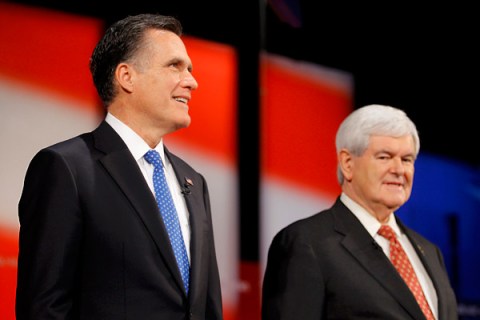
Republican presidential candidates Mitt Romney and Newt Gingrich stand on stage prior to a debate in Tampa, Jan. 23, 2012.
Mitt Romney and Newt Gingrich are locked in a virtual dead heat just days before Florida’s pivotal Jan. 31 primary, according to a new TIME/CNN/ORC poll.
Romney earns the backing of 36% of the state’s registered Republicans, a slight edge over the 34% who prefer Gingrich. Former Pennsylvania Senator Rick Santorum, who was belatedly declared the winner of the Iowa caucus, came in third in the survey, notching support from 11% of respondents. Texas Congressman Ron Paul, who is skipping Florida to concentrate on smaller caucus states, trails with 9%.
After three states produced three different winners, Florida has emerged as a turning point in the turbulent GOP primary season. The winner-take-all tussle for 50 convention delegates will test whether Gingrich’s momentum can survive a collision with Romney’s fat wallet and organizational clout in a large, diverse swing state with numerous media markets. In the days following Gingrich’s commanding victory in South Carolina, Romney’s lieutenants have launched bruising attacks on the former Speaker, recasting him as an unreliable leader who used his Washington connections to cash in as a lobbyist.
The new survey helps clarify the candidates’ respective sources of support. Romney leads Gingrich among female and white voters, voters over 50, and those with a college degree. Geographically, he is strong in the Tampa Bay area and the state’s rural and exurban regions.
Gingrich holds leads among men, Tea Party voters, self-identified conservatives—among whom he boasts a 10-point advantage—and born-again Christians. His fans also appear to be more committed than Romney’s. Four of five Gingrich backers say their minds are made up, compared to less than two thirds of the former Massachusetts governor’s supporters. Overall, 25% of respondents indicated they were liable to change their minds.
Methodology: In Florida, a total of 1,503 adults, including 410 registered Republicans, were interviewed by telephone using standard random-digit dialing methods. All respondents were asked questions concerning their registration status and basic demographics, and the entire sample was weighted to reflect statewide Census figures for gender, race, age, education and region of the state. 369 likely voters were identified based on each respondent’s party registration status (only registered Republicans were selected), stated intention to participate in the 2012 primary, interest in the campaign to date, and self-reported voting history. The poll has as sampling error of +/- 5 percentage points.