

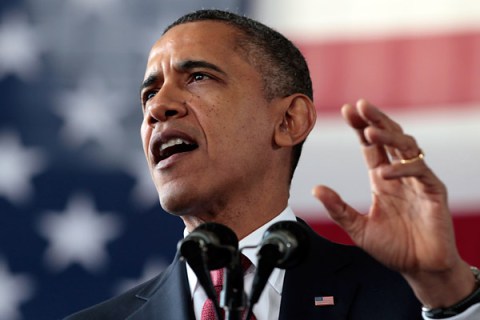
President Barack Obama speaks in the 440th Structural Maintenance Hangar at Fort Bragg, North Carolina, Dec. 14, 2011.
January 31 is set up to be a big day in the 2012 presidential presidential campaign. Not only will Florida voters go to the polls, possibly sealing the party’s presidential nomination, but most super PACs that have been dominating the airwaves in recent weeks will finally report their donors, revealing for the first time the financial sources for all the attacks. Almost certainly, during all the hoopla of these news events, another big number will be lost in the shuffle. On the day before, the Bureau of Economic Statistics is set to announce at 8:30 a.m. new figures for U.S. per-capita personal income growth for December of 2011. Who cares? Read on.
As I write in this week’s issue of TIME, available to all-access subscribers, presidential elections have a long history of behaving like referendums on the relative strength of the national economy. Bad economies–Jimmy Carter in 1980, George H.W. Bush in 1992–tend to punish the incumbents. Good economies–Richard Nixon in 1972, Ronald Reagan in 1984–tend to reward the incumbents. This is not always the case–think Al Gore in 2000–but the effect is statistically demonstrable. A forthcoming book by political scientists Christopher Wlezian and Robert Erikson, The Timeline of Presidential Elections, reviews the patterns for the last 15 presidential elections and finds that economic fundamentals explain 54% in the difference in election results from cycle to cycle. The political press tends to harp on the unemployment rate as a measure of economic health, but this is problematic. The better measure, say those who have run the numbers, is weighted cumulative real income growth on a per capita basis. (Weighted simply means that each quarter closer to an election date counts more than the quarter before.)
(MORE: Inside Obama’s World)
Which brings us to the January 30 BEA report. It will only be a snapshot, but it is one that matters. If the economy is going to recover enough to improve Barack Obama’s chances at reelection, it will have to start happening soon. Wlezian and Erikson also found that the economic fundamentals in April of an election year are generally almost as good a predictor of the final vote as the fundamentals in November.
So the question is this: As it now stands, just how bad does the economy look for Obama? The answer is pretty bad, by historic standards. Last fall, Douglas Hibbs Jr., ran the numbers and found that through the third quarter of last year, the economic performance under Obama predicted the president would get just 44.1% of the popular vote. That number was by no means set in stone, since there were still several quarter to come before the election, and each quarter would count more than the one that preceded it. But Obama does probably need to see a tangible pickup in economic growth to be comfortable. Hibbs estimates that the comfort territory would only come with a year-over-year 4% increase in per capita real income, though a 2% increase would bring the expected incumbent vote on election day up to 48.2%.
(PHOTOS: Political Pictures of the Week)
None of these figures are determinative. Hibbs model has successfully predicted each election since 1952 to within 2.5 percentage points, with the exception of two misses: 1996, when Hibbs model predicted a bigger Clinton win, and 2000, when Hibbs model predicted a bigger popular vote win by Al Gore. Political scientists generally agree that campaigns do matter–though they tend to cancel each other out–and that other factors like party identification, ideology and policy also affect the final vote. But the biggest single factor in moving the polls, presidential approval and the vote, in a time of general peace, is almost surely economic performance. And Barack Obama is short on time to put some better numbers on the board.