


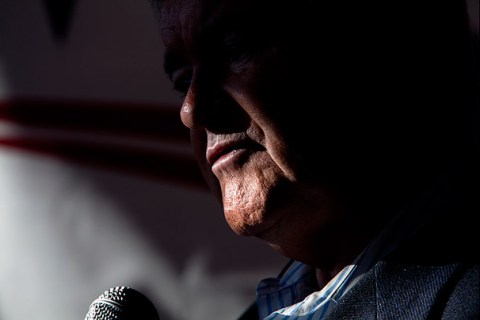
Republican presidential candidate Newt Gingrich holds a campaign meet and greet at Elly's Tea and Coffee Jan. 3, 2012 in Muscatine, Iowa.
Despite Saturday’s announcement that prominent Evangelical leaders would support Rick Santorum for President, the battle for social conservative votes is far from over. On Monday, backers of Newt Gingrich disputed reports that Evangelical leaders had reached a consensus to support a single candidate, as Family Research Council president Tony Perkins had announced following the Texas powwow on Saturday.
Five evangelical leaders who attended the meeting at former Texas Appeals Court Judge Paul Pressler’s ranch issued a statement via the Gingrich campaign stating that “there was no consensus regarding a candidate, and those of us that came supporting Newt Gingrich left still supporting Newt Gingrich whole-heartedly.”
Among the statement’s signatories were Christian pollster George Barna, Former Oklahoma congressman J.C. Watts, Jim Garlow, the pastor who championed an anti-gay marriage ballot initiative in California, Baptist pastor Richard Lee and Evangelical activist David Lane. Their statement continued:
Rick Santorum won the majority of the votes (by 9 votes in the first ballot), and he is to be congratulated for that. However, while we truly respect Rick Santorum and Rick Perry, we believe Newt Gingrich to be the only candidate that has the intellectual strength and the capacity to stop the Left’s attack on morality, the economy, basic freedoms and our religious liberty.
In addition, Mr. Gingrich is the social conservative that has the capacity to raise funds and produce a national organization that would allow him to compete with and defeat Barack Obama. For the sake of the nation, we remain steadfastly committed to Newt Gingrich.
Earlier this week, Tim LaHaye, the author of apocalyptic Christian fiction series Left Behind, also endorsed Gingrich.
The signals of support for Gingrich illustrate how fragmented social conservative leaders continue to be less than a week before South Carolina’s pivotal primary. Author and political adviser Doug Wead spoke in support of Ron Paul at the weekend gathering in Texas. “When the meeting was over, I had people swarming me asking me for my card,” Wead says. “They said, ‘My kids and grandkids support Ron Paul. As a born-again Christian, explain to me how you came to support him.’ They are curious.”
Prominent Christian P.R. consultant Mark DeMoss was on hand to make the case for Mitt Romney. But if Evangelical voters splinter as their leaders have, Romney won’t need the support. The only thing standing between him and the nomination is a consensus social conservative who can rally the faithful in South Carolina. Monday’s statement was more evidence that such a candidate doesn’t exist.