

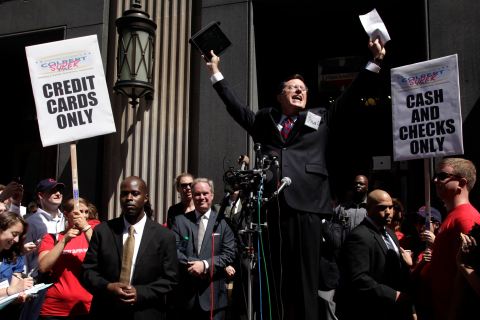
Stephen Colbert greets a jubilant crowd outside the headquarters of the Federal Election Commission after the FEC approved his proposal to establish a so-called Super PAC in Washington on June 30, 2011.
Stephen Colbert is laughing at the U.S. Supreme Court. He started Thursday night on his show, when he transferred control of his super PAC to his mentor, business partner and friend Jon Stewart. Here is the clip:
[vodpod id=Video.15950896&w=425&h=350&fv=]
It’s a great set piece of comedic theater underscored by a serious argument: Justice Anthony Kennedy, joined by a majority on the Supreme Court, issued a ruling in 2010 rewriting the nation’s campaign-finance rules that is, on its face, pretty absurd.
The argument is actually worth exploring in some detail. Since the 1970s, many lawyers and judges have argued, quite reasonably, that the First Amendment’s right to free speech should permit anyone — an individual, a corporation or a union — to spend as much money as desired to influence elections. This argument posits that this sacred right to self-expression around elections simply trumps the danger that the large sums of money could corrupt the political process. It is a balancing test — the First Amendment on one side, the public interest in avoiding corruption on the other — and reasonable people can reach different conclusions about where the fulcrum should be placed.
But that is not what Kennedy and the Supreme Court did in the Citizens United case. In the majority opinion, the court agreed with past court rulings that the threat of corruption trumps the First Amendment rights of a person, corporation or union to give unlimited amounts of money to politicians for use in campaigns. But then Kennedy and the high court created a huge carve-out based on a factual statement: “We now conclude that independent expenditures, including those made by corporations, do not give rise to corruption or the appearance of corruption.”
In other words, Kennedy stated that if a wealthy individual, corporation or union spends its money to support its candidate independently, the First Amendment does not have to be more important than the threat of corruption. Rather, “corruption or the appearance of corruption” is simply no longer a threat. Candidates would no longer feel the need to repay their contributors with favors, and contributors would no longer feel they could influence the candidates with the money. The key word here is independent. And as I write in this week’s issue of TIME, available online to subscribers, this word, in the 2012 presidential campaign, does not really mean in practice what it seems to mean on paper.
It all comes down to the legal interpretation of independence that has been proffered by the Federal Election Commission. This regulatory body has decided that candidates can be considered independent of a supporting group as long as the candidate does not privately communicate with that group about the way it spends its money. That’s it. If the candidate appears at the group’s fundraisers to speak, the group is still independent. If the candidate publicly approves of the work the group is doing, the group is still independent. If the group is run entirely by former staff and close friends of the candidate, the group is still independent. If the group’s leaders tell donors they will spend all their money in a way that coincides with the candidate’s own public strategy, the group is still independent. If the candidate slips up, as Romney has done, and suggests publicly that a donation to the group is a donation to himself, the group is still independent.
And so we get the case of Jon Stewart and Stephen Colbert and the Definitely Not Coordinating with Stephen Colbert Super PAC, which has been established with the clear intent of showing how much coordination is still allowed without triggering the legal definition of coordination. It is a grand experiment. And it clearly mocks the logic the Supreme Court and the Federal Election Commission have constructed. If anyone thinks Stephen Colbert will not take note of, or be grateful for, contributions to the Definitely Not Coordinating with Stephen Colbert Super PAC, they can step forward now. As Rick Tyler, who is running the Newt Gingrich super PAC, told me for my TIME article on the topic, “It’s a big shell game.”
UPDATE: The Supreme Court’s reasoning is about to be further put to the test. Tyler, who runs Winning Our Future, previously told me that he takes his strategic cues from Gingrich’s public statements. Today in Florida, Gingrich called on Winning Our Future to pull its King of Bain attacks on Romney. The Los Angeles Times reports, “Rick Tyler, a spokesman for the PAC, responded that he was ‘aware of and share the speaker’s concerns about accuracy’ and promised a more thorough response would be forthcoming.” If Tyler does what he said he would do and follows Gingrich’s lead, there will be little doubt that Gingrich effectively controls Winning Our Future, even if he legally is not coordinating with the group.