


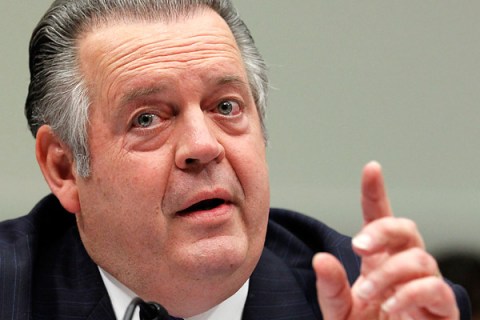
Richard Land, president of the Ethics and Religious Liberty Committee of the Southern Baptist Convention, testifies on Capitol Hill in this file photo from July 14, 2010.
Some 125 evangelical leaders and their spouses will gather this weekend at a Texas ranch to discuss the latest iteration of Operation What To Do About Mitt Romney. While organizers say it is not a meeting to stop the GOP front runner, the invitation is urgent: “This coming election could prove to be the most critical of our lifetime,” it reads. The real kicker: Event sponsor and former American Family Association chairman Don Wildmon has asked invitees if they would be “be willing to compromise and change your choice to one that the body as a whole supports in order to not divide our strength,” according to someone who has received the invitation. The implication? Time’s running out to anoint a consensus candidate for social conservatives.
Getting all the members of this group, let alone the voters of South Carolina, behind this proposition in the middle of January will likely require an act of God. Evangelical votes and donations are already splintered between Newt Gingrich, Rick Perry and Rick Santorum. (Ron Paul and Jon Huntsman, despite their second and third place finishes in New Hampshire, will not be under consideration at the ranch outside Houston this weekend.) There is a rumor among several invitees that the leaders may ask a candidate to withdraw, but entrenched loyalties will make it difficult to settle on one or possibly two contenders to take to the fall. Wildmon financed Perry’s “Response” prayer rally this summer, and event organizer Gary Bauer, a former Family Research Council president and a U.S.-presidential hopeful in 2000, endorsed Santorum at a South Carolina campaign event this past Sunday.
Despite the fact that Romney is benefiting from social conservative splintering, organizers insist the event will not be an anti-Romney fest. “If this were a stop-Romney meeting, I would not attend,” says Bauer, who notes that the meeting was planned two weeks before Iowa. But as the clock runs down, the distinction thins. They are looking to end the divisions that are poised to save Romney from a serious challenge in South Carolina. Reported-attendee Richard Land, president of the Southern Baptist Convention’s Ethics and Religious Liberty Commission, describes their choices this way: “Newt’s a brilliant guy. But Newt doesn’t have baggage—Newt’s got freight. Perry, at least this go-around, is not a credible presidential candidate because of his gaffes and his goofs. And Santorum, is he a recognizable national figure? Can he raise the money? Can he become competitive?”
Signs indicate that if the group can settle on one candidate, Santorum is the most likely. Although he is Catholic, his social positions mirror evangelicals’ on gay marriage and abortion. “He has less apparent downside than the other two and more apparent upside,” Land says. “It would be nice to try to unite around one of the three remaining candidates and have a go at being competitive with Romney in the primaries.”
Even if evangelical leaders unite, it’s not clear how competitive Santorum will be with voters. Romney claimed 35% of South Carolina born-again Christians while Santorum notched 22% in a TIME/CNN/ORC poll conducted last week. And at this point, even Land admits that “Romney may be the most conservative candidate who could get elected” and that his fellow social conservatives may have to “settle.”
In the end, winning against Barack Obama takes highest priority for the group gathering again in Texas. “There’s a growing trend that evangelicals want to win, and there’s a dose of pragmatism settling in,” says Mark DeMoss, a Romney supporter and president of the DeMoss Group, the nation’s largest PR firm catering to Christian clients. That doesn’t mean they can’t wish. “We can always marry the boy next door,” says Land. “But maybe we ought to go out on a hot date with the tall dark stranger first.”