


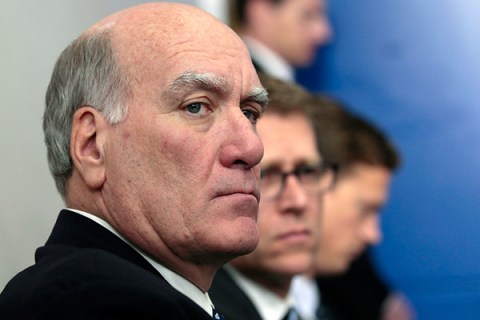
White House Chief of Staff William Daley, left, and White House Press Secretary Jay Carney, center, listen during President Barack Obama's news conference in Washington, Dec. 8, 2011.
For months now, Bill Daley has been living in a sort of Washington purgatory. His title, White House chief of staff, usually the second most powerful job in Washington, remained the same. But his role was something less. Over the holidays, he decided it was not a job he wanted to keep.
Last week, Daley told the President that he planned to resign, and return to his hometown of Chicago. Obama, who had recruited Daley a year earlier and invested in him the hopes of a presidential revival before the 2012 election, asked Daley to reconsider. A day later, Daley returned. He had not changed his mind. The news was first reported Monday by the Los Angeles Times.
“In the end the pull of a hometown we both love,” President Obama told the press on Monday, “was too great.” The President then offered the standard explanation for any public servant who leaves office under surprising circumstances: “Bill felt he wanted to spend more time with his family, particularly his grandchildren,” Obama said. Daley will be replaced as chief of staff by Jack Lew, a lifelong Washington manager and policy wonk, who is currently running the Office of Management and Budget.
Daley’s tenure in the White House was not particularly distinguished, even though President Obama praised him Monday for achieving great success. After a string of run-ins with Congress, Daley lost the confidence of Democratic Congressional leaders and largely failed to woo Republican leaders despite an initial outreach effort. His effort to court business leaders and Wall Streeters, one of the major selling points of his appointment, never really got off the ground either, in part because of the divisiveness of the coming election season. His role as a high-level surrogate for Obama in the media, another key part of his initial duties, hardly materialized, and the interviews he gave on the record often created problems by being too candid or off-message.
Inside the West Wing, his ability to manage was also called into question. In early November, Daley ceded some of his management responsibilities to Pete Rouse, a golden-boy in the Obama inner circle who had passed on taking the chief of staff job last year and supported Daley’s appointment. Should Daley have stayed on, the year ahead would have placed Daley in a decidedly reduced role. He had already largely removed himself from much of the message planning, which was overseen by David Plouffe and the Chicago campaign strategists. The legislative portfolio was largely handled by deputies. Daley was left in an ambiguous position: He still ran the White House on paper and, aides maintained, in reality, but most actual leadership tasks were out of his hands. It was a position that Daley and the rest of the White House staff seemed resigned to maintain until after the election.
In an October interview, Daley told a NBC Chicago affiliate, WMAQ, that he had already told the President that he would leave Washington. This was an odd move, one that marked Daley as a lame duck and an outsider because most native Washington power players see any admission that their jobs might end as a sign of weakness. Weeks later, Daley stunned staff in the White House by giving an extended, on-the-record interview to Politico’s Roger Simon, an old Chicago acquaintance. In the interview, Daley referred to the first three years of the Obama administration as “ungodly” and “brutal.” He blamed “both Democrats and Republicans” for making it difficult for Obama to act as “anything like a chief executive.” He even joked that his predecessor, Rahm Emanuel, was not all that “beloved” by other White House aides.
The primary reason Emanuel caused tensions in the White House—a propensity to create drama when less was needed—was exactly the impact that Daley had by speaking with Simon. He gave off the impression of an executive waiting out one more year in a job, working for a man he admired, in an ungovernable town he disliked. Daley appeared to have committed a cardinal sin in public life: He had been too honest about how he felt in public.
In his resignation letter, Daley took a far more cautious and conventional approach. After praising the President’s accomplishments, and noting that the past year had been “one of great challenge for the administration,” Daley wrote simply, “I have been honored to be a small part of your Administration. It is time for me to go back to the city I love. I wish you and your family the very best in 2012.”