


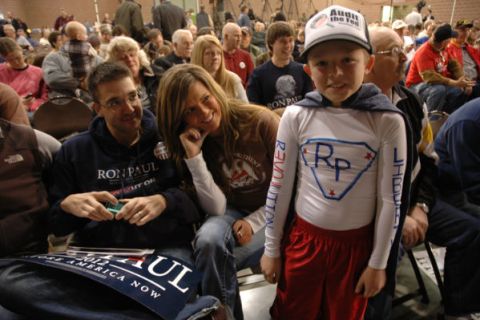
Dawson Lee, 10, attends a Ron Paul rally in Des Moines, dressed in full liberty gear, on Dec. 28 2011. His parents look on.
Des Moines, Iowa
Through the booms and busts of the Iowa campaign—Michele Bachmann, Herman Cain, Newt Gingrich—Ron Paul has steadily built his following in the Hawkeye State, where he now sits atop the polls. But popularity comes with pitfalls: more scrutiny, more attacks, and the difficult task of turning his supporters’ raw enthusiasm into a winning coalition.
Paul has been criticized from almost all sides in these last few weeks. Flailing rival Newt Gingrich has painted him as the whack-a-doodle GOP uncle, saying on Tuesday that he wouldn’t even vote for the Texas congressman if he got the nomination. Rick Santorum placed Paul, who wants to shrink America’s military presence worldwide, “to the left” of President Obama on foreign policy. Conservative pundit Bill O’Reilly recently said that those same non-interventionist views disqualify Paul as an American. Iowa Gov. Terry Branstad emphasized the importance of the runners-up when asked about the possibility of a Paul victory: “It’s who comes in second and who comes in third,” Branstad told CNN, “as well as who comes in first.”
Despite what many of Paul’s supporters see as full-on establishment warfare against his candidacy, Paul was in a statistical tie for first place with Mitt Romney in a CNN/TIME/ORC poll of likely caucus-goers released Wednesday.
Those who agree with Paul love him fervently—one Iowa couple dressed their child up as a Ron Paul-themed super hero for a rally on Wednesday. The zealous Ronulans and Paulists, as they’re called, hail his consistency, candor and respect for the Constitution; even new-comers to his rallies say Paul’s respect for the holiest of American political documents is the most genuine in the field. But there are also warning signs that other voters might prove hard-to-win converts, at least for the long haul. Forty-one percent of likely Iowa caucus-goers say they would not consider supporting Paul under any circumstances—the highest percentage of any candidate.
On Wednesday morning, Paul spoke at an intimate town hall in Newton, Iowa. Locals packed a building in the middle of the Iowa Speedway, coming out to see what this guy, the one they had been hearing so much about recently, had to say. “I’m just more curious than anything else,” said Annie Pigott, a 22-year-old student preparing for her second caucus. “Everyone else is sort of saying the same thing, and he really has a different point of view, which is cool.”
The speech she heard would only seem different to someone who had not encountered Paul before. The candidate stuck to his rhetorical mainstays: America’s problematic divergence from the Constitution; the need for liberty; the urgency of paying down the country’s debt and cutting spending; abolish the Federal Reserve; chuck the Department of Education; cut off foreign aid. He ping-ponged between doom-and-gloom about what will happen if the government doesn’t change and how much better things can be if it does. He often had to pause for rounds of applause.
The post-speech Q&A led off on another familiar tangent, an inside-baseball discussion about returning to the gold standard, during which Annie Pigott, a potential convert, started paying more attention to her cell phone than to the candidate. Paul bared his wonky side again in the afternoon when visiting a local insurance company. His opening was all central banking, inflation, artificially low interest rates. When asked if she had liked the speech, if she felt inspired to get out and caucus on Jan. 3, claims worker Cathy Baker paused. “Hmm,” she said. “I feel like looking more.” Her friend Heather McReynolds remained unconvinced: “It still makes me wonder, what can [politicians] really change?”
And as thrilling as Paul’s supporters find his policy prescriptions, they can breed backlash as well. In the evening, protestors made an appearance at Paul’s veterans’ rally in Des Moines. A few minutes into his speech, a mother and daughter started yelling that Paul was part of the “one percent” and accused him of not supporting women. A fight almost broke out between the veterans there to support him and the interlocutors. The congressman’s speech was drowned out, first by the 99-percent cries and then by chants of “Ron! Paul! Ron! Paul!” The candidate had only one thing to say: “Freedom of speech, ain’t it wonderful?!” (Cue rapturous applause.)
If Mitt Romney is vanilla, Ron Paul is coconut–voters seem to either love him or hate him. The question remains: How far can that kind of candidate go?