


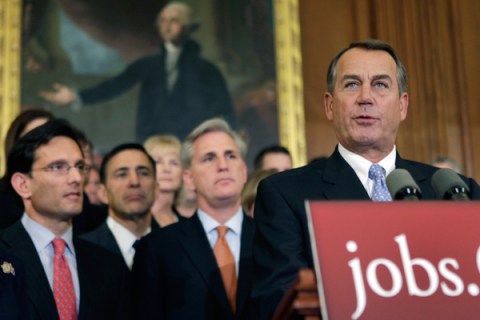
Speaker John Boehner speaks to the media after the House vote on the Senate version of the payroll tax cut extension on Capitol Hill in Washington, December 20, 2011.
Updated: 10:13 a.m. Friday
On the fifth day since rank-and-file Republicans bucked a two-month extension of the payroll tax cut, the House GOP finally gave way under pressure. Senate Minority Leader Mitch McConnell gave the last push Thursday, calling on his House colleagues to pass a short-term measure and move on to separately negotiating a new, year-long deal. Depending on whom you ask, McConnell’s statement either constituted throwing Speaker John Boehner to the wolves or throwing him a face-saving lifeline. Either way, Boehner was in an unenviable position, and after a few hours, he relented. Congress passed a two-month extension with minor tweaks on Friday, ending the high-stakes legislative drama that’s become winter tradition in Washington, D.C.
“House Republicans sensibly want greater certainty about the duration of these provisions, while Senate Democrats want more time to negotiate the terms. These goals are not mutually exclusive,” McConnell’s Thursday morning statement read. “Leader Reid should appoint conferees on the long-term bill and the House should pass an extension that locks in the thousands of Keystone XL pipeline jobs, prevents any disruption in the payroll tax holiday or other expiring provisions, and allows Congress to work on a solution for the longer extensions.”
From a political standpoint, McConnell’s shift was understandable. Democrats were convinced they had the better of the issue and they launched a full-on shame offensive to make as much hay as they could. At a public event Thursday afternoon, President Obama trotted out a room full of people who’d responded to his “40 dollars” campaign, named for the amount of money that the cut’s expiration would take out of a standard biweekly paycheck, and drew a direct line between their plight and the gunked-up works of the Capitol.
“This is exactly why people get so frustrated with Washington,” Obama said. “This is an issue where an overwhelming number of people in both parties agree. How can we not get that done? Has this place become so dysfunctional that even when we agree to things we can’t do it? It doesn’t make any sense. Enough is enough. The people standing with me today can’t afford any more games. They can’t afford to lose $1000 because of some ridiculous Washington standoff.”
Earlier in the day, Speaker Boehner had maintained that he would only pass a year-long extension. “It’s better for jobs. It’s better for the economy,” he said. And in fact, he’s right; a two-month extension will be difficult to implement properly on short notice according to payroll experts. In his last political parry, Boehner invited Obama’s economic advisers to Capitol Hill to press the logistical side of the issue, but the White House declined.
In essence, McConnell’s statement and Boehner’s eventual agreement mark a concession to Democrats, agreeing to a compromise that Senate Majority Leader Harry Reid had already offered: to reconcile differences through a conference committee after the House sucks it up and passes the short-term extension. Obama was quick to point this out. “The House needs to pass a short term version of this compromise, and then we should negotiate an agreement as quickly as possible to extend the payroll tax cut and unemployment insurance for the rest of 2012,” he said. “Just a few hours ago, this is exactly what the Republican leader of the Senate said we should do.”
It’s a bitter pill for the House to swallow and one off the few times congressional Democrats have remained unmovable in the final hours of a fierce debate this year. The rank-and-file members who derailed the extension on Saturday are a wary bunch: the 2011 budget deal passed in April and the debt ceiling agreement struck in August left bitter tastes in many conservative members’ mouths. And both those deals came after conservatives had already won concessions from Democrats by digging in their heels. This time, they were able to win no such 11th-hour prizes.