


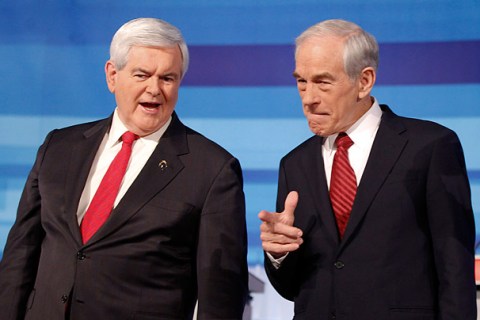
Republican presidential candidates, former House Speaker Newt Gingrich, left, and Rep. Ron Paul, R-Texas, at a Republican presidential debate in Sioux City, Iowa, Dec. 15, 2011.
The overall primary picture is still muddy, but several surveys released over the weekend found Newt Gingrich’s lead erased in Iowa and lessening nationwide. If current trends continue, Ron Paul seems well poised to win a split decision in Iowa, setting up an Establishment-vs.-insurgency fight with Mitt Romney, which historically hasn’t worked out well for the insurgent. But whatever happens, it’s instructive to look at why Newt’s Icarian flight to the top of the Republican presidential primary polls is ending.
The best explanation probably lies with the TV-ad spending in Iowa, which has its most pronounced effect in the final weeks before the caucuses. Here’s First Read:
THIS WEEK: Restore Our Future PAC (pro-Romney), $713,000; Rick Perry, $456,000; Mitt Romney, $258,000; Make Us Great Again (pro-Perry), $186,000; Red White and Blue Fund (pro-Santorum), $100,000; Ron Paul, $63,000; and Newt Gingrich, $21,000. That’s right, folks: The pro-Romney super PAC is outspending the Gingrich campaign 34 to 1. And yes, that isn’t a ONE-DAY Gingrich ad buy, that’s his total spending on the books for THE WEEK.
This illustrates a few things. For one, negative ads are effective. The Romney-Paul onslaught is clearly generating a lot of heat, and Gingrich’s waxen wings are melting underneath it. Second, Gingrich probably hasn’t raised a significant amount of money since his boomlet began in November; it’s very difficult to believe he’d be spending only in the low five figures at this point if he wasn’t stretched thin; he’s reportedly prepping a $240,000 TV buy, but at this point, it looks like triage. Third, new campaign-finance laws are already shaping the 2012 contest. Romney Super PAC is spending about as much as all the other traditional campaigns combined. And on a related point, Romney isn’t soft-pedaling Iowa. He’s dumping a whole lot of money into Iowa, which suggests that he’s convinced he can effectively end the campaign against Gingrich early with a decent finish there. (He’s also spending in South Carolina and Florida — he has a lot of money to spread around.)
More abstractly, there’s also a possibility that Gingrich’s brazenness, which helped him ascend to the top of the leaderboard, has not served him well as a front runner. His decision to double down Sunday on his proposal to subpoena “activist” judges with whom he disagrees and use the power of federal marshals or Capitol police to haul them before Congress is hard to understand. It may support Romney’s argument that Gingrich is too “zany” to be trusted with the nomination in some voters’ minds.
And in the end, I think that’s the story of the GOP primary: a search for trust. Republicans voters trust that Romney can beat Obama but hardly trust anything else about him. In every other candidate they’ve turned to, they’ve been looking for someone they can trust not to mess up what should be a favorable election year. But Gingrich was tarred by a sketchy past, Bachmann was gaffe-prone, Perry was unintelligible, Paul was eccentric, and Cain was all of the above with a side of alleged lechery.