


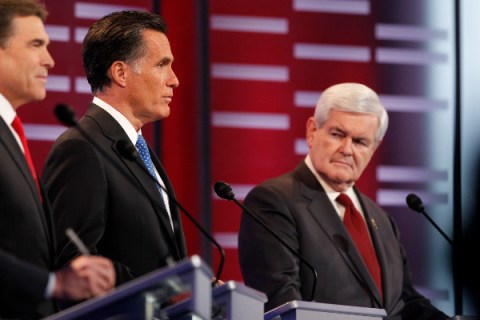
Rick Perry, Mitt Romney and Newt Gingrich at the ABC News Republican Presidential debate at Drake University in Des Moines, Iowa, Dec.10, 2011.
In a crucial Saturday night debate that marked the beginning of the final, frantic sprint to the Iowa caucuses, Newt Gingrich weathered an onslaught of attacks from his Republican rivals and emerged relatively unscathed, solidifying his perch atop the field just 23 days before the Jan. 3 caucuses.
Hosted by ABC News, the debate was just the second of the 2012 cycle to be aired on national network television and the first in which Gingrich entered as the national front-runner. For months, Gingrich had harnessed the glut of debates to resurrect his sputtering candidacy. Now, in the first of two debates set in Iowa over a five-day span, his challenge was to parry his rivals’ barbs and avoid a major miscue that would blunt the momentum that has propelled him to a double-digit lead in the primary campaign’s opening battleground.
From a political perspective, he succeeded. Moderators Diane Sawyer and George Stephanopoulos repeatedly teed up opportunities for rivals to go after Gingrich, raising questions about his support for a health-insurance mandate, his history of adultery and his incendiary claim that Palestinians are an “invented” people. His rivals repeatedly portrayed Gingrich as a Washington insider with a history of bucking conservative dogma. It was the pile-on that the prior week of attacks presaged.
But few of the salvos seemed to stick, and Gingrich, who broke his vow to remain “relentlessly positive” almost immediately, gave as good as he got. In a memorable confrontation early in the debate, Mitt Romney — asked to enumerate policy points on which he and Gingrich differed — appeared tentative, ultimately falling back on the familiar argument that his own private-sector background is better preparation for the Oval Office than Gingrich’s lengthy stint in Washington. “Let’s be candid,” Gingrich retorted. “The only reason you didn’t become a career politician is you lost to Teddy Kennedy in 1994.”
It wasn’t the worst moment for Romney. While sparring with Rick Perry over whether Romney had scrubbed a line about his Massachusetts health-care plan from a later version of one of his books, a visibly irked Romney extended a hand and offered to bet Perry $10,000 that he had not. It was a particularly tone-deaf remark from a candidate laboring to shake the stigmas of his privileged upbringing and vast personal fortune–and one of the race’s memorable missteps. An aide to Jon Huntsman — who has declined to contest Iowa and failed to meet the polling benchmark to qualify for Saturday’s debate — said the campaign had already purchased the website domain 10kbet.com, and the DNC distributed an e-mail pointing out that $10,000 is a sizable chunk of the average American’s yearly wages.
Romney recovered and, during a colloquy with Gingrich, made a compelling case that the former House Speaker’s incendiary remarks about the Middle East peace process underlined his penchant for recklessness. But he, like the others, was unable to put a real dent in Gingrich. At one point, Stephanopoulus asked each of the candidates whether infidelity should be a deal-breaker for a presidential hopeful. “I think people have to render judgment. I’ve said in my case, I’ve made mistakes at times — I’m also a 68-year-old grandfather and I think people have to measure what I do now,” Gingrich said.
It was one in a series of topics that veered from the economic issues that have dominated such forums throughout the year. Instead, big blocks of time were eaten up by questions that invited candidates to delve into their biographies by accentuating their humble roots and compare their respective friendships with Israeli Prime Minister Benjamin Netanyahu. Other questions retraced old ground on immigration and health care.
Absent Huntsman and Herman Cain, the six-person debate offered each of the race’s second-tier candidates — Perry, Michele Bachmann and Rick Santorum — greater air time than usual, and each delivered one of their better performances of the cycle. But it was unclear which, if any, was able to break through as they vie to rally the state’s social-conservative bloc around their candidacies. Ron Paul, who is running nearly neck-and-neck with Romney, had a relatively quiet debate, but with perhaps the best ground game in the state and the most motivated supporters, he had perhaps the least at stake of anyone onstage Saturday night.
By contrast, the debate was the biggest test yet for Gingrich. After clawing his way from irrelevance to the front of the pack, the former House Speaker needed to prove, under the crucible of the national spotlight, that he is more durable than past pretenders whose front-runner status was fleeting. He seemed to do just that on Saturday.