

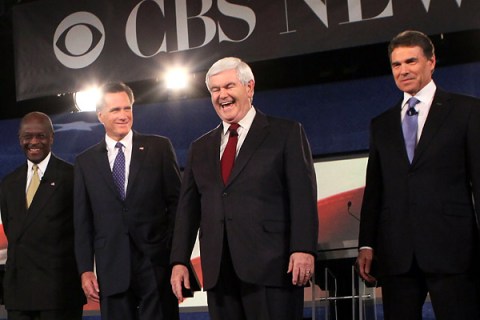
Republican presidential candidates, from left to right, Herman Cain, Mitt Romney, Newt Gingrich and Texas Gov. Rick Perry stand on the stage prior to a presidential debate at Wofford College Nov. 12, 2011 in Spartanburg, South Carolina.
The Republican Presidential candidates will gather tonight for their eleventh televised debate, and as usual the media mob is teeming with predictions and storylines to watch. I can’t help but wonder if the power of debates has peaked, and we’re headed into a more traditional, and less cheaply theatrical, stage of the primary campaign. It’s been noted that retail politics have counted for less in 2012 than in any recent cycle, for a few reasons: The campaign got off to a late start. The man to beat, Mitt Romney, has been laying low, and has mostly avoided Iowa. Romney rivals like Newt Gingrich, Herman Cain and Michele Bachmann have either struggled to build strong ground games or have seen their state staffers quit. Tim Pawlenty, who had a great Iowa ground game, dropped out. And, of course, the debates have proved nearly as entertaining as that episode of “The Jersey Shore” where The Situation flew into a rage and smashed his own head into a wall.
But now the campaign’s dynamics are changing, with traditional elements like television advertising and retail politicking growing vastly in importance. Romney, Rick Perry, and even Jon Huntsman have all kicked off robust ad campaigns in Iowa and/or New Hampshire. Others will soon follow, at least those who can drum up the cash. Romney has just signaled that he will in fact play to win in Iowa’s caucuses, a process that has long rewarded nitty-gritty grassroots organizing ahead of national media attention. That, in turn, will force all his rivals to work harder there. Candidates like Gingrich and Cain, with the help of increased campaign cash, are already beefing up their ground operations in multiple states. Important local pols are holding splashy endorsement events, while newspaper editorial boards are preparing their own endorsements–and are insisting that the candidates sit down for some ring-kissing first. And it only stands to reason that primary state voters are expecting to hear more from the candidates about their parochial issues and concerns. No one talked about ethanol at the CBS News foreign policy debate, but you can bet Iowa voters still want to hear from the candidates about it–preferably in person.
And the debates are, frankly, starting to feel played out. Sure, it’ll be interesting to see whether Newt Gingrich can avoid shooting off his mouth when he faces an inevitable new degree of badgering by rivals and debate moderators. Romney is still fascinating in the manner of a man on a high wire: for the drama of seeing whether he’ll make a false step and plunge to his demise. But even the most entertaining reality shows grow old before long. Does anyone really need to see Gingrich castigate another debate moderator, or Perry choke on his tongue again? Probably no more than we need to watch Snooki hit the Jersey Shore clubs yet another time. Forget the cheap drama on your TV tonight; it’s time to start reading the Des Moines Register.