


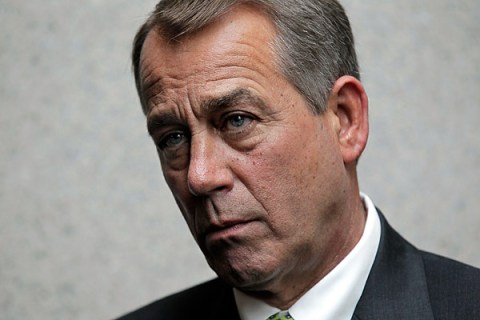
Speaker of the House John Boehner of Ohio is seen following a Republican strategy session in Washington, Nov. 15, 2011.
During House Speaker John Boehner’s first stint in the leadership in the mid 1990s, just about the only adornment on the walls of his tiny Capitol Hill office was a portrait of Nicholas Longworth, the last Speaker from Ohio. Longworth, who reached across the aisle to form a close working bond with House Minority Leader John Nance Garner, has long been Boehner’s idol. In fact, Boehner’s first moves as Speaker to re-empower the committees and the structures of the House mirrored similar steps taken by Longworth when he won the gavel in 1925. Unfortunately for Boehner, that is where the similarities ended.
While Boehner made a career of working with the likes of former Massachusetts Senator Teddy Kennedy, brokering big pieces of legislation like No Child Left Behind and the 2005 pension reform bill, he is at odds with a Republican conference more interested in burning bridges than building them. Twice this summer Boehner tried for a grand bargain on deficit reduction and twice the deal collapsed, in part because there just wasn’t support from within his own conference for the increased tax revenue that Democrats demanded.
Fast forward three months, and Boehner is in much the same place. While he is tempted to engage with Senate Majority Leader Harry Reid to broker a supercommittee deal, he is also faced with a Republican conference not wild about what’s on the table. Boehner has backed a plan put forth by Senator Pat Toomey, a Pennsylvania Republican and former head of the anti-tax group Club for Growth, that is also supported by all six Republicans on the supercommittee. That proposal would increase tax revenues by $300 billion while lowering the top taxable income bracket from 35% to 28%. “I think the offer that the Republicans put on the table is a fair offer,” Boehner told reporters on Tuesday.
But even House Majority Leader Eric Cantor, Boehner’s No. 2, has repeatedly refused to endorse the plan. Rep. Patrick McHenry, a North Carolina Republican, got 100 of his GOP colleagues to sign a letter opposing any new revenue. And while Rep. Jeb Hensarling, one of Boehner’s representatives on the supercommittee, delivered a well-received pitch for the Toomey plan in a Tuesday GOP conference meeting, most members who came up to congratulate him afterwards declined to support it. “Most responses were, “Hell no,”’ said one aide who witnessed the scene.
Earlier on Tuesday, Boehner met with Democratic Senate Majority Leader Harry Reid. Reid asked Boehner about recent comments by Grover Norquist, head of the anti-tax group Americans for Tax Reform, that the Toomey plan was nothing but a negotiating position and Republicans would never actually vote for increased tax revenue. Reid wanted a gut-check on where Boehner stood. While the Speaker last week dismissed Norquist as “some random person,” he left the meeting with Reid non-committal. He was equally non-committal when asked by GOP members about that meeting, shrugging and saying he couldn’t always read the Majority Leader.
Boehner’s office is quick to point out that the Toomey plan is the only one out there right now that has support. After more than a week, Democrats have yet to give a counter offer. “I’ve offered $1,000 to any reporter who can find a Democratic plan that can get more than one vote in the Senate,” says Michael Steel, a Boehner spokesman. “That money’s still in my pocket… The Speaker is doing everything possible to make sure that the Joint Select Committee reaches its goal.”
Still, it’s clear that supercommittee members have taken negotiations as far as they can. While Boehner, like other congressional leaders, has stayed involved through staff and his representatives in the room, it’s clear that if a deal is to be had it will have to come from the leaders personally hashing things out – something Boehner hasn’t seemed to want to do, just yet.
Not getting a deal could be embarrassing for Boehner and his conference, potentially inciting further disgust with Congress from a public already at its limit with the institution and its entrenched interests. From a political standpoint, doing something – even something half-baked – would be better than doing nothing. Not only are there political consequences if the committee deadlocks, but markets would likely react badly, and a deadlock would trigger automatic across-the-board cuts at the Pentagon and in entitlement spending, two especially bitter pills to swallow. Boehner’s problem is that his partner in the Senate, Minority Leader Mitch McConnell, has little incentive to help him. Neither do House Democrats. And with Boehner’s freshman having trouble fundraising and congressional Democrats nearly doubling their Republican counterparts’ haul last month, doing what’s politically smart has never had such an appeal to the GOP rank-and-file.
Boehner’s negotiating style has always been to use the last minute urgency before a deadline to extract the best possible deal for him and his members. He could be playing this game again, but the best possible deal in this case might not be enough for his conservative members. Democrats rejected Toomey’s proposal as too expensive – lowering the tax rates would decrease revenues by as much as $4 trillion over the next decade, a gaping hole $300 billion in new tax revenue does little to plug. And if the Toomey plan would have trouble garnering a majority of Republicans, something to the left of Toomey’s plan would surely fail. Which means that while Boehner may be tempted to try and broker a deal here, more likely he won’t be able to, which would be the death knell for the supercommittee’s chances of success.