


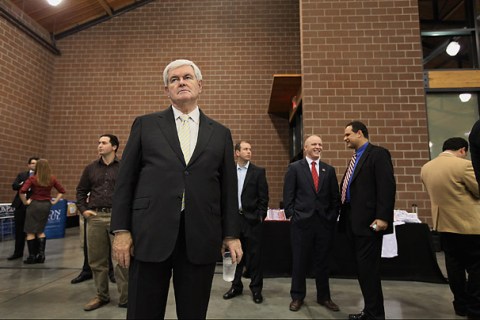
Republican Presidential Candidate Newt Gingrich listens to a speaker at the Iowa Faith & Freedom Coalition Presidential Forum on Oct. 22, 2011 in Des Moines, Iowa.
The New York Times reported today that Gingrich was uncharacteristically downbeat in Iowa on Tuesday, despite his surging poll numbers. Perhaps this, first reported by Bloomberg, is the reason why:
Newt Gingrich made between $1.6 million and $1.8 million in consulting fees from two contracts with mortgage company Freddie Mac, according to two people familiar with the arrangement.
Gingrich’s business relationship with Freddie Mac spanned a period of eight years. When asked at the debate what he did to earn a $300,000 payment in 2006, the former speaker said he “offered them advice on precisely what they didn’t do,” and warned the company that its lending practices were “insane.” Former Freddie Mac executives who worked with Gingrich dispute that account.
You must understand: to Republican stalwarts, a relationship with Freddie Mac is the moral equivalent of satanism. Gingrich was a paid helper–and, believe me, he didn’t get paid $1.6 million to lecture the organization on the failures of government intervention in the market–in a “socialist” effort to make home-buying easier for people who ordinarily wouldn’t be able to afford houses, an effort that famously went off the rails when the government began supporting sub-prime and other highly questionable mortgages.
In other words, Gingrich was supporting–the best guess was that Gingrich was hired to win some Republican support for Freddie– the very sort of program that he routinely excoriates. This sort of hypocrisy is astounding but, sadly, not unknown to Newt. After all, this was the guy who led the Republican Impeachment of Bill Clinton while having an extra-marital affair of his own.
This is one of those what-on-earth-was-he-thinking? moments that pockmark presidential politics. Sort of like John Edwards paying a staffer to “father” his illegitimate child in 2008. Didn’t Newt understand that if his campaign took off, his employment record would be subject to scrutiny?
He has now, in a single elegant act, proved himself to be the sort of politician Tea Party activists–and many of the rest of us–despise: he talks a good game, but is secretly taking money from the Washington Establishment sorts he pretends to disdain. On the Democratic side, I’d put Chris Dodd–who took loans from the scam-artists at Countrywide mortgage while working on housing legislation–in the same category. In a classic moment of Gingrichism, Newt recently suggested that Dodd belonged in jail. There are differences in the circumstance, as there were with Clinton: Dodd was a public servant when he lay down with the lice; Newt was a private citizen. (Clinton was alleged to have perjured himself in the Paula Jones case; Newt was merely a sexual scoundrel.) But the enormity of the hypocrisy in this case confounds the imagination of even an occasional political novelist like me.
And it confirms the growing sense that the right-wing of the Republican Party is the chosen home these days of political nitwits, scoundrels and charlatans.