


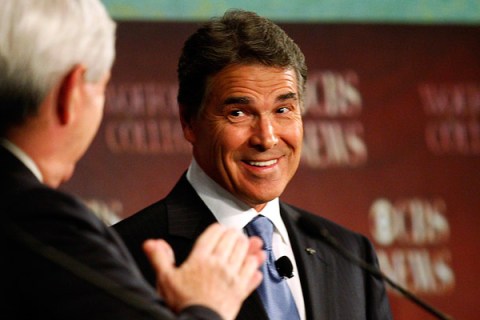
Republican presidential candidate Rick Perry looks toward fellow candidate Newt Gingrich as he answers a question during a South Carolina Republican party presidential debate in Spartanburg, Nov. 12, 2011.
Rick Perry is no incrementalist. In a bid to reignite his sputtering campaign, the Texas governor has adopted the mantra that while his Republican rivals would paper over Washington’s problems, Perry would arrive toting a wrecking ball. “I do not believe Washington needs a new coat of paint. I think the whole place needs to be overhauled,” Perry said Tuesday, during a speech at a manufacturing plant in Bettendorf, Iowa. “We need to uproot, tear down and rebuild Washington, D.C. and our federal institutions.”
He is, in a sense, attempting the neat trick of running for government in order to dismantle it. Presenting himself as a “Washington outsider,” Perry unveiled a litany of proposals that would indeed go a long way toward changing Washington’s structures and traditions.
Perry would try to root out cosseted career politicians by turning Congress into a part-time gig for citizen-legislators, halving members’ $174,000 salary in the process. To rein in activist judges, he would pursue a constitutional amendment to scrap Supreme Court justices’ lifetime appointment to the federal bench, instead implementing 18-year terms — an idea that will surely please federalists. He would scrap three federal agencies and downsize two others, make it harder to raise taxes and veto all new unfunded government mandates. Amid the outrage kicked up by a 60 Minutes report that raised questions about Congressmen using privileged information to capitalize in the stock market, Perry’s also calling for a ban on insider trading by the much-reviled legislative branch.
It’s all so bold as to be not so bold at all. Viewed through the prism of his sliding position in the polls and his need to change the subject from last week’s damning debate gaffe, Perry’s gambit appears to be the kind of desperation heave favored by candidates without a lot to lose, with a calculated shock-value that shades into pander. It’s likely that Perry’s proposals will strike a chord with elements of the Republican base. They could also backfire.
But the aggressive anti-Washington rhetoric is worth the risk. It’s a month and a half until the Iowa caucuses, where Perry must finish in the top tier to justify his presence in the race, and the Texas governor has sagged to 7% in today’s Bloomberg poll, far beneath the quartet of Mitt Romney, Newt Gingrich, Herman Cain and Ron Paul.
At the speed GOP voters are churning through candidates for the role of Romney alternative, there’s still a chance that Perry could receive another audition. He has the money to take advantage if that happens. This is the kind of speech that create buzz for a candidate — and just as often comes back to haunt them.