

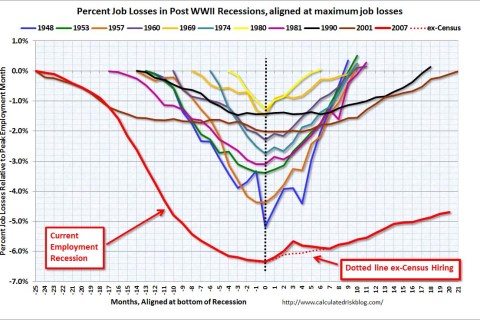
Friday’s jobs report offered yet more evidence of an infuriatingly glacial recovery. The U.S. economy added 80,000 jobs in October, nudging unemployment down one tenth of a percent to 9.0%. Economic minds wiser than mine observed some bright spots in the report. But the basic fact remains that while sputtering back into recession is unlikely, at this point, accelerating into recovery is every bit as improbable:
What is unusual about this recovery is that even as the economy is improving there doesn’t seem to be an increase in the pace of improvement. In other jobs market rebounds, one month’s 100,000 jobs gain leads to 200,000 the next month. Every new person with a jobs spends more money and that typically leads to more and more jobs. But that’s not happening this time around. The reasoning at this point is familiar. The overhang in debt has curtained spending. That’s really true in the housing sector. Home construction typically leads the economy out of recession. But with prices still falling and foreclosures continuing, home buying has not picked up. In fact, in October the number of construction jobs fell by 20,000.
This crystallizes President Obama’s unique re-election problem. Of course, housing metrics, and the unemployment and annualized growth rates are just numbers. There’s no arbitrary point where people decide that they’re not voting for the incumbent because 8.1% joblessness would be tolerable, but by gum, 8.2% is beyond the pale. But voters are heavily influenced by their perception of change over time. In this next year before the election, will everyday things–wages, grownup offspring living at home, out of work friends, kitchen table budgets, home values–get better or worse?
On paper, we know that some of these things are getting better. But data like Friday’s jobs report show it’s happening so slowly that Americans cannot feel it. Polling backs this up. Now the President has less than a dozen monthly jobs reports and three quarters of growth to make them feel it or, as Nate Silver covered exhaustively in his recent Sunday New York Times Magazine piece, his re-election effort will face strong headwinds.
This imperceptible progress has also had the effect of freezing most policy options. Things aren’t improving fast, but they’re not getting worse, so a deadlocked Congress and cautious Fed are standing pat. There are no major fiscal or monetary interventions planned for the next 12 months, and it’s not likely that there will be the kind of economic downturn that could galvanize such action. So, Obama is stuck.