


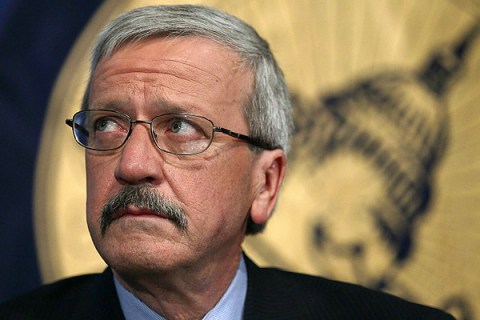
Republican presidential candidate Herman Cain's chief of staff, Mark Block, listens to Cain speak at the National Press Club in Washington on Oct. 31, 2011
The Milwaukee Journal Sentinel ran a stunning piece on Monday unraveling the twisted, potentially illegal financial spider web connecting Herman Cain’s presidential campaign and Prosperity USA, a Wisconsin corporation founded by Cain campaign manager Mark Block and his deputy Linda Hansen.
According to internal company records, Prosperity USA gave the Cain campaign $40,000 for iPads, flights and other expenses. The transactions were not reported in the campaign’s financial disclosures, a possible violation of federal election law. As the Journal Sentinel reported, the source of Prosperity USA’s money, including $150,000 in mystery loans, is hard to identify. But Wisconsin campaign attorney Michael Maistelman told the paper that “the number of questionable and possibly illegal transactions conducted on behalf of Herman Cain is staggering.”
(MORE: Will Cain Allegations Hurt Him in Early Primary States?)
Block has faced allegations of breaking campaign law before. In 2001, he agreed to pay $15,000 and stay out of Wisconsin politics for three years to settle charges that he illegally used money from an outside advocacy group to fund the successful campaign of state supreme court justice Jon Wilcox. The legal battle left Block broke and stocking shelves at Target.
After his ban was up, Block returned to politics as the state director of the Wisconsin chapter of Americans for Prosperity, a conservative advocacy organization founded by billionaires David and Charles Koch. It was through AFP that Block met Cain, and over the course of several years, the political vet created a series of independent organizations with prosperity in the title, including Prosperity USA and a group called the Wisconsin Prosperity Network, which was supposed to spend more than $6 million a year promoting conservative organizations in the region.
(MORE: Why Harassment Claims Won’t Sink Cain’s Campaign)
Paul S. Ryan, an attorney at the Campaign Legal Center, says the expenditures by Prosperity USA represent potential tax-law violations for the nonprofit and that Cain’s campaign, as well as the candidate himself, could face sanctions for campaign-finance-law violations. “It certainly looks like some laws were probably broken,” Ryan says. “It is hard to say, because this is such a mess. The attorneys who were in charge of this did not have a good grip on campaign finance law.”
In an e-mail to TIME, Block wrote, “As with any suggestions of this type, we have asked outside counsel to investigate the Milwaukee Journal Sentinel‘s suggestions and may comment, if appropriate, when that review is completed.”