

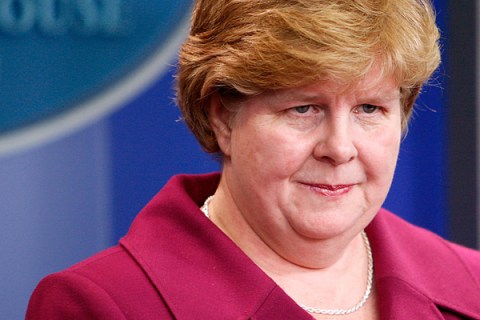
In this Feb. 11, 2010 photo, Christina Romer, then Council of Economic Advisers chairwoman, briefs reporters at the White House in Washington.
On Sunday, the Obama Administration’s former top economist, Christina Romer, put to paper an idea she has been bandying about for a while: The Federal Reserve, she argues, should restate its mission and commit to returning the U.S. economy to its pre-recession path, as measured by nominal GDP, or the size of the economy before accounting for inflation. In practice, this would commit Ben Bernanke to seeking out higher rates of inflation in the short term, at least until the economy catches up to its previous trajectory and starts growing at a healthy rate again. But the genius of Romer’s plan, at least for those who see it as genius, is that it doesn’t sound like a plan to raise inflation in the short term. It sounds like a plan to get the economy growing again. The economic crises got the nation off track, she reasons, so the Federal Reserve should get it back on track.Such a strategy has been used before, Romer argues. In the late 1970s and early 1980s, the U.S. economy faced another problem, runaway inflation. To respond, then Fed Chairman Paul Volcker publicly announced that he would set a targeted rate of monetary growth, sending a clear signal that 10% inflation would have to go one way or another. Economic behavior changed, the American people suffered through a recession, and those high rates of inflation have not been seen since.
In Romer’s view, a similar communications strategy in the other direction could have a similar effect. By committing to higher inflation until the economy started growing, nominally, on the same path it was on pre-crisis, the expectations of investors and consumers would shift. The rub comes in just how the Federal Reserve would meet this new target of increasing inflation to make up for a lack of normal economic growth. Romer explains:
Though announcing the new framework would help, it probably wouldn’t be enough to close the nominal G.D.P. gap anytime soon. The Fed would need to take additional steps. These might include further quantitative easing, more forceful promises about short-term interest rates, and perhaps moves to lower the exchange rate. Such actions wouldn’t just affect expectations; they would also be directly helpful. For example, a weaker dollar would stimulate exports.
In other words, the Federal Reserve would have to create a lot more money. And this is not a popular notion in a post-Tea Party nation. But Romer says money printing in a nicer way. As Paul Krugman puts it, the Romer plan is “arguably mainly a relatively palatable way to state a strategy that’s ultimately about something else. . . . [S]ay that we need to reverse the obvious shortfall in nominal GDP, and you’ve found a more acceptable way to justify huge quantitative easing and a de facto higher inflation target.”
To be sure, Romer is not proposing a return to the huge, unending inflation numbers of the Carter years. But it still suggests that inflation, which despite the Facebook postings of Sarah Palin, has been basically absent in recent years, would return with a bang. This would be a good incentive to spend now, before prices go up. It would also lower the burden of outstanding debts, like underwater mortgages. With higher inflation, your home value and income are likely to go up. Your mortgage payment, by contrast, will stay the same.
But Romer’s proposal also flies in the face of an anti-inflation orthodoxy that has reigned in the United States since the 1970s. Polls regularly show that the American people fear inflation as a bad thing, even though inflation at a moment of static demand and high debt could actually help the country as a whole. Changing those views will require a lot more than a policy shift by Ben Bernanke, and will probably require a snappier slogan than the “nominal gross domestic product framework.”