

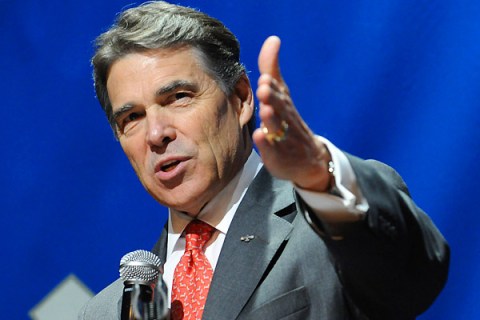
Republican presidential candidate Rick Perry speaks at the Western Republican Leadership Conference in Las Vegas, Oct. 19, 2011
Texas Governor Rick Perry’s tax plan curves hard to the right, but will GOP front runner-Mitt Romney swing at the pitch?
Perry’s plan, introduced Tuesday in a Wall Street Journal op-ed and followed by a speech in South Carolina, would create an alternative flat tax system that tax payers could opt into if they choose. From Perry’s op-ed:
The plan starts with giving Americans a choice between a new, flat tax rate of 20% or their current income tax rate. The new flat tax preserves mortgage interest, charitable and state and local tax exemptions for families earning less than $500,000 annually, and it increases the standard deduction to $12,500 for individuals and dependents.
The plan was greeting warmly by most conservatives. “Rick Perry’s flat tax is pretty cool,” Grover Norquist told TIME on Tuesday morning. “What Perry did is taking current structure and crunches down into a parallel structure. And if you want to shift over to new one, you can. If there’s some secret problem that emerges, you don’t have to do it. Everyone can feel safe as they build this alternative structure because you don’t have to go into the building until you’re sure it’s safe.”
It’s not clear all Americans will be so quick to embrace it. Loosely based on Hong Kong’s tax structure, a similar plan proposed by John McCain during the 2008 campaign was met with derision – the non-partisan Tax Policy Center found that it would add $7 trillion to the deficit over a decade. And fiscal critics already have their red pens out for Perry’s plan.
“This is a deficit buster,” says Professor Len Burman, a tax expert at Syracuse University’s Maxwell School. “It would probably create even bigger deficits than McCain’s plan because it’s more radical.” The problem, Burman argues, is that the only people who have an incentive to switch over are the rich, who would get a massive tax cut. Not only would their rate drop from 35% to 20% but all capitol income – not just gains but dividends, royalties and interest – would also be exempt. “Capital income accounts for more than half of today’s tax revenues,” Burman says. The plan would also cut taxes for single people who earn more than $34,500 and couples who make more than $69,000 combined.
The Perry campaign has yet to release full details of the plan and there remain a lot of questions. For instance, it’s unclear if taxpayers would be allowed to move back and forth between the two income taxes or only get to switch once. The fate of corporate taxes, particularly expenditures and deductions for things like health care is equally murky. But politically, the plan has already served its purpose.
With Perry, Herman Cain and even Newt Gingrich now all endorsing some form of flat tax, Romney will feel pressure to follow suit. “I continue to be disappointed that Governor Romney has yet to embrace a flat or fair tax,” said Club for Growth President Chris Chocola. “He would be wise to avoid using class warfare when comparing his current proposals to those of Governor Perry or Herman Cain. The Club for Growth is looking for bold leadership on tax reform from the Republican nominee – not demagoguery or platitudes.”
And Romney’s tax stance now seems timid in comparison. Norquist rates Perry’s plan his favorite aomng the candidates’ thus far for two reasons: it has a stated goal of shrinking government spending to 18% of GDP–“This is what I couldn’t get the Bush people to do in 2005 rather than have imaginary conversations with imaginary Democrats who wouldn’t consider reforming Social Security,” Norquist laments– and “there’s not a theme” to Romney’s vague plan. (Norquist discounts Cain’s 9-9-9 plan outright as a tax increase.)
The Texas Governor has created something of a box for his chief rival. Perry’s plan is so far to the right, there is no way for Romney to out flank him as he has on immigration. And the flat tax itself might put Romney on his heels. In 1996 he called Steve Forbes’ signature proposal a sop to “fat cats.” This year, Romney hedged. “I love a flat tax,” he said, though he went on to express reservations that such a tax might disproportionally hurt middle class Americans. “It would be difficult but not impossible given the flexibility of Romney as a politician to adopt a flat tax plan now,” says Dan Mitchell, a tax expert at the conservative Cato Institute. “But certainly if Perry’s plan takes off, Romeny will have to respond.”