

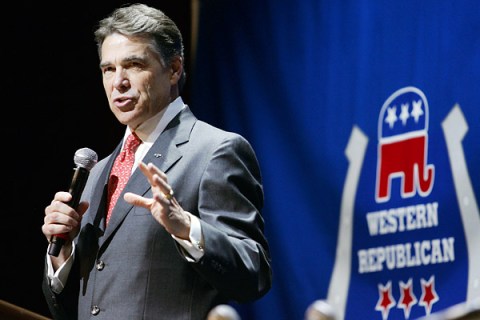
Texas Gov. Rick Perry speaks during the Western Republican Leadership Conference Oct. 18, 2011, in Las Vegas.
Herman Cain isn’t the only candidate vowing to junk the unwieldy federal tax code and replace it with a simpler structure. On Wednesday, speaking to attendees at the Western Leadership Conference in Las Vegas, Rick Perry announced that implementing a flat tax would be one of the centerpieces of his plan to spur economic growth. “It starts with scrapping the three million words of the current tax code, and starting over with something much simpler: a flat tax,” Perry told attendees at the Western Leadership Conference in Las Vegas.
Perry withheld key details of his plan, which he’ll unveil in a speech next week. But embracing the flat tax is a move fraught with risk. Perry is among the highest-profile presidential contenders in history to hook his Oval Office hopes to the flat tax, a controversial idea that has ricocheted around the right for decades but which is derided by opponents as a regressive system that slashes taxes for the wealthy while increasing them for nearly everyone else.
The flat tax has multiple variations, but the basic idea is to replace the progressive scale presently in use with a single, fixed rate and jettison deductions, credits and taxes on income accrued through investment. Since being popularized by a pair of Stanford economists in the early 1980s, the flat tax has intermittently surfaced in presidential campaigns, often as a way for second-tier candidates to capitalize on frustration with the byzantine tax structure by urging an uncluttered fix. Steve Forbes’ 1996 presidential bid is a famous example of this phenomenon, but not all the candidates who used the flat or fair tax as a springboard have been conservative — as Steve Kornacki notes, Jerry Brown harnessed its appeal to great effect in the 1992 Democratic primary, and in the Senate Arlen Specter was a recent proponent.
In recent years, amid historically low tax rates and the rise of the Tea Party, the issue has become a rallying point on the right, as investors decrying outsize, redundant tax burdens clamor for ways to flatten and simplify the code. “The idea — even though it has been a while coming in the U.S. — has been gaining traction around the world, ranging in size from Albania to Russia,” Forbes told the Daily Caller. “So we’re catching up with the rest of the world.”
We don’t yet know what form Perry’s proposal will take, though Forbes, who’s advising Perry, indicated to the Daily Caller that like his own, it would include an exemption for low-income individuals. But it’s likely to provoke a familiar set of complaints from centrists and progressives who argue, as they did with Cain’s plan, that it would benefit the wealthy at the expense of ordinary taxpayers.
Flat tax plans are “clearly regressive,” says Steve Wamhoff of Citizens for Tax Justice, a non-partisan group which advocates on behalf of progressive tax policies. “They give huge tax cuts to the rich and the increases go lower and middle-income people.” According to Citizens for Tax Justice, the flat tax legislation floated by Specter in 2010 would have generated large cuts for the wealthiest 5% of the population and an average tax hike of nearly $3,000 for the remaining 95%. Cain’s 9-9-9 plan has been shredded by Bruce Bartlett and other analysts for similar reasons.
Unlike Brown or Forbes, Perry began his presidential bid as a heavyweight contender. Embracing a controversial idea may help him curry favor with conservatives — the Tea Party group FreedomWorks, whose chairman Dick Armey is a longtime flat tax advocate, is a leading proponent of the idea — but it could prove a liability in the general election, and Perry is already fighting the perception that a swaggering Texan will be a tougher sell next November than a polished technocrat like Mitt Romney. Polling on the flat tax is scant, though a 2005 survey by an anti-tax group called the Tax Foundation found broad support for the concept.
Next week’s speech will highlight one of Perry’s primary challenges as the race hurtles into its next phase. To this point, Perry’s campaign has been stalled in the introductory stage, his advisers stressing his bootstrap personal story, his cowboy mien, his rugged conservatism. To be sure, he’s spent plenty of time talking about his job-creation record in Texas and energy independence. But he’s done little to articulate a vision of how he would fit his Lone Star State policies to the national stage. Emphasizing personal characteristics rather than policy expertise — a not-so-subtle ploy to pummel Romney in the likability primary — has come at a price. Perry’s back story is growing familiar to voters, but they’re neither sure what he believes nor, apparently, whether they like him.
Take, for example, a fascinating new Washington Post/Pew Research Center poll that asked voters to list words they associated with the leading Republican presidential hopefuls. For Cain, the leading response was his “9-9-9,” his ubiquitous tax plan. For Perry, the overwhelming response was “Texas,” followed by “no,” “idiot/idiotic,” “conservative,” and “governor/governor of Texas.” In the wake of several weak debate performances, even staunch conservatives are expressing suspicions about Perry’s suitability for the presidency.
Whether a flat tax allays those concerns is an open question. It’s an idea in vogue on the right, and if packaged shrewdly, one can envision it finding favor with the millions of Americans weary of a complex code shot through with loopholes. It could be the spark Perry’s flagging campaign needs. But it will face a fusillade of criticism, and it’s propelled past presidential hopefuls only so far before it flamed out.