

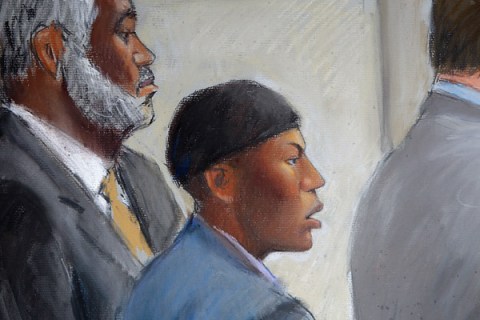
Omar Farouk Abdulmutallab, center, appears in U.S. District Judge Nancy Edmunds' courtroom in Detroit in this courtroom drawing, Oct. 12, 2011. Abdulmutallab was on trial for charges resulting to his attempt to bring down an international flight over Detroit using a bomb in his underwear.
Last week Omar Farouk Abdulmutallab pleaded guilty in a Michigan court to conspiring to blow up Detroit-bound Northwest Airlines flight 253 on Christmas Day 2009 using a bomb sewn into his underpants.
The plea, which came on the second day of the trial and surprised prosecutors, was quickly touted by Attorney General Eric Holder as an example of how civilian trials can be an effective tool in the fight against extremist Islamic groups, like Al Qaeda in the Arabian Peninsula (AQAP), from whom Abdulmutallab allegedly received training and materiel for his plot.
“Contrary to what some have claimed, today’s plea removes any doubt that our courts are one of the most effective tools we have to fight terrorism and keep the American people safe,” Holder said in a statement.
In his understated—not to say timid—way, Holder was trying to score points against Congressional Republicans, and some Democrats, who had made hay with Holder’s decision to Mirandize Abdulmutallab on his arrest, and to prosecute him through the civilian, Article 3 judicial system, rather than putting him through the newly erected and still largely untested military tribunal system.
In the wake of the failed bomb attempt, House Judiciary Chair Lamar Smith introduced a (potentially unconstitutional) bill requiring the Justice Department to consult the Director of National Intelligence and the Secretary of Defense before offering Miranda rights to a suspected terrorist. Smith said, “The President’s policy of appeasing terrorists has failed. As we saw on Christmas Day, closing Gitmo has not made America safer. Giving terrorists constitutional rights ignores the seriousness of the threat from al Qaeda—these are acts of war, not isolated incidents of crime. All terrorists should be interrogated by intelligence experts to obtain crucial information about future attacks. Anything less risks the safety and security of the American people.”
But if Holder feels he’s winning the argument against Congress, he doesn’t seem to be doing much about it. The administration, after laborious inter-agency negotiations, cleared 36 individuals held at Guantanamo Bay for trial, either in civilian courts or through the Article 3 system. So far only Ahmed Ghailani, a suspect in the 1998 bombing of American embassies in East Africa, has been brought to trial; his trial ended with a conviction and a life sentence on one charge, but with not-guilty verdicts on 284 other charges. Again, Republican leaped on the trial as evidence civilian courts were not a safe place to try terrorists.
None of the other 36 has been brought to trial. The Obama administration’s version of military commissions are being set-up under the leadership of Army Brig. Gen. Mark Martins, a Rhodes Scholar who graduated first in his class from West Point and has an impressive resume as the veteran of multiple U.S. nation-building experiments abroad. He is preparing to try the alleged mastermind of the 2000 attack against the USS Cole, Abd al-Rahim al-Nashiri, and is struggling to bring his staff up to the level needed for rigorous trials.
Supporters of civilian trials now want Holder to pivot off the Abdulmutallab plea and push for some of the 36 to be tried in civilian court, but there is little indication that he has the stomach for that, especially as his boss heads into an election season in which national security and Obama’s handling of terrorism is likely to play a role.