

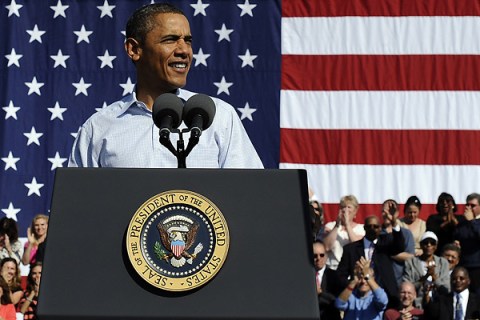
President Barack Obama speaks at the Asheville Regional Airport in Fletcher, North Carolina, on Oct. 17, 2011.
Confronted with a President who has killed Osama bin Laden and an almost comically long list of his deputies and associates–being al Qaeda’s military commander is like being the Spinal Tap drummer–the Republican presidential candidates have struggled to attack Obama’s national security policies. They went after his Libya intervention, then piped down after the fall of Gaddafi and the absence of an Islamist government in his place. Obama was supposedly enabling a Muslim Brotherhood takeover in Egypt until it turned out that he was in effect backing a status quo military dictatorship. Few on the right are complaining about his detention and interrogation policies, not even after Obama officials Mirandized a suspected Iranian-backed terrorist on U.S. soil this week.
Republicans have generally settled on the broad critique that Obama has been weak in his support for popular uprisings in Iran and Syria, and that he has traveled the world apologizing for America’s actions abroad, which bears little resemblance to reality. And then there is, of course, the charge that Obama has abandoned Israel, throwing the Jewish state “under the bus” by pressuring Bibi Netanyahu to freeze settlements and strike a peace deal with the Palestinians. Note that Republicans are ardently courting disenchanted Jewish Democratic donors.
But this week’s news about an audacious, bizarre–and, some suspect, overblown–Iranian plot to kill the Saudi ambassador in Washington suddenly thrusts Obama’s policy towards Tehran back into the political conversation in an explosive way.
Republicans had grown quiet about Iran and its ongoing nuclear program in recent months. That’s partly thanks to regional distractions like the Arab Spring, and a recent lull in the Green Movement’s public demonstrations . It’s also a tribute to Obama’s success at winning strong new sanctions against Tehran at the United Nations last year, temporarily placating conservatives who had been bashing him for extending a hand to Iran soon after he took office.
But the weird Iranian plan to kill Adel al Jubeir is reminding the right of their loathing for Tehran, that Iran’s nuclear program has been steadily marching on, and their sense that Obama has gone soft on Iran’s leaders. On Fox News last night, John McCain complained that the new sanctions are not doing enough harm, and insisted that Obama take tougher steps against the country’s leadership and shipping industry. The GOP candidates still seem to be sorting out their exact reactions to the alleged terror plot–Rick Perry seized on it to talk about border security, of all things–but with a new poll showing that almost half the country views Iran as an “enemy” of the U.S., they surely see the political opportunity here.
The big question is whether the coming months will reignite the debate about a potential military strike to disable Iran’s advancing nuclear program. With some expert warning that the window to inflict serious damage on that program is closing, the GOP’s Iran hawks may reassert themselves. Several of those hawks are advisers to Mitt Romney, for instance, and last week Romney advocated rattling our saber by moving U.S. aircraft carrier groups to the eastern Mediterranean and the Persian Gulf region. Rick Santorum, Herman Cain and even the foreign policy minimalist Jon Huntsman have all said military strikes on Iran might be necessary to stop its nuclear program, while Michele Bachmann calls Iran’s nuclear program “the most important thing.”
For his part, President Obama has remained measured, saying that Iran must be held “accountable” for the terror plot, but not taking any visible steps just yet. However, some experts think the plot may have dealt the final blow to Obama’s long-standing hopes for a diplomatic solution to the nuclear standoff. If so, that places into the 2012 debate a fundamental, and extremely unpleasant, question. Namely, which is worse: a military strike on Iran–or a nuclear-armed Iran?