

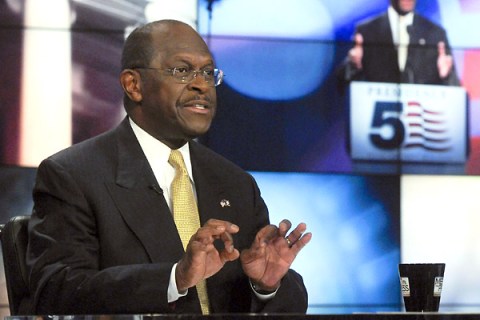
Republican Presidential candidate Herman Cain appears on "Meet the Press" Oct. 16, 2011 in Washington.
There’s some talk this morning about whether various things Herman Cain said this weekend will pop his super-inflated bubble. Maybe, but not everything plays with base Republican voters the way Washington thinks it does. Take Cain’s controversial line about building an electrified border fence. If you’ve seen the video, you’ll note that a lot of people in the crowd cheered. Cain now says he was only joking, though it didn’t sound that way to my ears; but I’m not even sure this is such an outrageous position within conservative Republican circles. Republican voters are furious over immigration. (I’ll never forget the Iowa man I saw urging Tim Pawlenty to consider issuing a lethal force threat against Mexican border-crossers.) Think about the degree to which this single issue derailed the Rick Perry rollout.
A bigger problem for Cain is his admission to NBC’s David Gregory that his vaunted 9-9-9 tax plan would raise taxes for some people. That opens a pretty clear avenue for attack. You can easily imagine the Iowa mailer from Michele Bachmann or even Rick Perry titled, “Will Herman Cain Raise YOUR Taxes?“
Ultimately, though, there may be no sense dwelling in statements like these so long as Cain demonstrates a total lack of depth on national security. On the hardest questions, like Afghanistan and Iran, Cain’s default answer seems to be that he can’t offer an informed opinion unless he gets classified briefings. (Which incidentally is absurd: A senior U.S. policymaker on Afghanistan once told me he often gets the best information about that country from newspaper articles.) And when Cain does go beyond basics, he tends to say weird things: On “Meet the Press” he warned that the exit of U.S. troops from Iraq would enable Iran to “attack” Baghdad, which isn’t really what anyone’s worried about; it’s Iranian political influence that U.S. officials fear.
I’d be surprised if many Republicans care whether Cain is aware of what “neoconservatism” means. But basic credibility as a commander in chief is a hurdle every presidential candidate must clear. And Cain utterly flunks on that score. Which is why it’s entirely reasonable to treat his candidacy more like the world’s most entertaining book tour than political history in the making.