

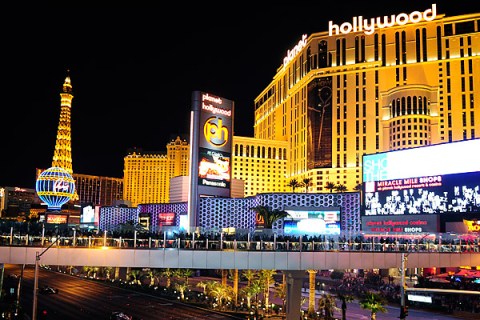
Lights illuminate Las Vegas Boulevard on Oct. 13, 2011 in Las Vegas, Nevada.
Four second-tier Republican presidential hopefuls — Michele Bachmann, Newt Gingrich, Jon Huntsman and Rick Santorum — are threatening to bypass the Nevada caucuses if they take place Jan. 14, as presently planned. This is not, as you might surmise, because they’re sticklers for following RNC guidelines (which the Silver State skirted by bumping up its date in response to similar maneuvers by Florida and South Carolina) or deeply invested in preserving the sanctity of the GOP’s primary calendar. It’s a simple pander.
None of the four candidates are real contenders in Nevada, where Mitt Romney coasted four years ago and is favored to repeat. Each wants to showcase their fealty to the voters and kingmakers of New Hampshire, whose critical first-in-the-nation primary could choke off their presidential aspirations.
This is particularly true of Huntsman, the first to make noise about a Nevada boycott. The former Utah governor doubled down on his call Friday morning by bowing out of next week’s GOP debate in Las Vegas. Huntsman called the move “an effort to preserve New Hampshire’s historic first-in-the-nation primary status.” But that status isn’t in doubt. New Hampshire Secretary of State Bill Gardner, who has the power to set the date of the primary, has said it will take place sometime in December or early January. The only question is whether New Hampshire will have the same week-long buffer before the next contest that it has enjoyed in the past. “Your primary is critically important,” Huntsman told a New Hampshire Rotary Club on Thursday. That is doubly true for the candidate, who has staked his presidential hopes on a strong showing in the state and therefore has every reason to kowtow to its residents.
The calculus isn’t much more complicated for the likes of Bachmann and Santorum, who have made Iowa the centerpiece of their primary calendars. If public displays of solidarity with New Hampshire tradition can boost their lowly poll numbers, great. If not, a mass boycott partially illegitimizes Nevada, allowing them to skip the state and zip straight to South Carolina, where their brand on conservatism will find greater favor with the state’s legions of Evangelical voters. Gingrich, meanwhile, has been gaining ground in the Granite State and may opt to concentrate his campaign’s early-state resources there if the trend continues.
And what of the candidates who are resisting the boycott cry? Romney is the Nevada frontrunner. Rick Perry has the resources to compete and received a key early endorsement from Nevada’s Republican governor, Brian Sandoval. Ron Paul plans to make a play for the state, whose libertarian bent matches his own. “Dr. Paul is in this to win, and our campaign will compete for delegates everywhere we think we can win them,” said Jesse Benton, Paul’s campaign chairman. And the never-conventional Herman Cain has adopted an inscrutable early state-strategy that today took his surging campaign to Tennessee, of all places. (Update: According to New Hampshire’s WMUR, Cain’s camp said Friday afternoon that he will join the boycott.)
It takes courage to boycott a state you might win. This is naked self-interest.
Updated, 4:10 PM