

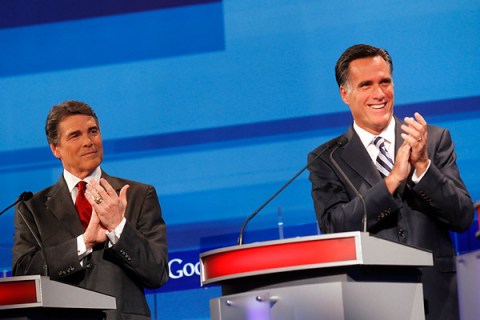
Republican presidential candidates Rick Perry, left, and Mitt Romney, applaud during the Fox News/Google GOP Debate in Orlando, Fla., Sept. 22, 2011.
After weeks of shaky debates and swirling questions about his record in Texas, it’s no surprise that Rick Perry is running behind Mitt Romney in head-to-head general election matchups against Barack Obama. Perry lags 12 points behind Obama, 50% to 38%, in TIME’s new poll, while Romney trails the President by a 46% to 43% margin, within the margin of error in most polls. Thirteen months before the election, the utility of horserace figures is limited. Still, the poll captures a useful snapshot how Perry’s support has softened even among the conservative blocs that seemed poised to rally behind his candidacy.
There are two areas in particular that should give immediate pause to Republicans looking ahead to a general-election tussle. For one, Romney is far better position to vie for the independent voters who help swing tight battles. He leads Obama among self-identified independent likely voters, 45% to 42%. Obama, by contrast, has a 47% to 39% edge over Perry in the fight for the same group.
The second area where the former Massachusetts governor boasts an edge is in the Midwest, home to an industrial corridor where the shrinking manufacturing base and sluggish recovery has dragged down Obama’s support. The ability to retake states like Ohio and Indiana would be a critical boost to the Republican nominee’s prospects, and Romney, who hails from Michigan — the state his father ran for a stretch — is in better position right now to accomplish that feat. Romney leads Obama in the Midwest by seven points, 46% to 39%. Perry trails the President in the region by the same seven-point margin, 45% to 38%.
But Perry’s most alarming area of under-performance is among evangelicals, a conservative faction squarely in Perry’s wheelhouse. This is a governor whose revival rally filled a Houston football stadium, who courts conservative bigwigs in language that reveals a Biblical fluency. Less than a week ago, a Perry supporter sparked a kerfuffle by suggesting that Romney, a Mormon, would not appeal to Evangelicals on the hunt for a true Christian candidate rather than an adherent to a “cult.” And yet in TIME’s poll, Romney outperforms Perry among Evangelicals, leading Obama 51% to 39%. Perry leads Obama among Evangelicals as well, but by a slimmer 46% to 40% margin. That head-to-head deficit in a prime Perry demographic may underscore the degree to which his faltering performance has sowed doubts among potential supporters.
The poll, conducted for TIME by Abt SRBI, surveyed 1,001 voters on Oct. 9-10.