

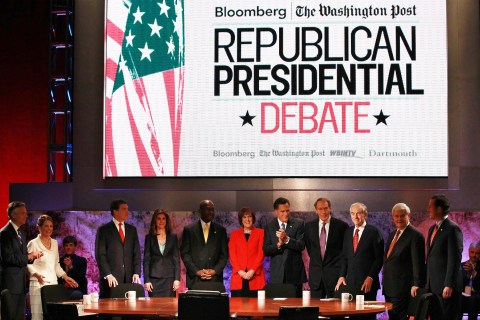
Jon Huntsman, Michele Bachmann, Rick Perry, Herman Cain, Mitt Romney, Ron Paul, Newt Gingrich and Rick Santorum gather prior to the start of the Republican Presidential debate on Oct. 11, 2011 at Dartmouth College in Hanover, New Hampshire.
The settings of the Republican presidential primary debates have shifted, as have the roles played by each candidate and the amount of intra-party flak flung about. But the fundamentals remain unchanged: Mitt Romney is sailing through these televised forums unbuffeted by any serious challenge from his rivals.
Tuesday night’s debate at Dartmouth college in New Hampshire featured eight familiar candidates crowded around one table, an economic theme and a more prominent role for surging political neophyte Herman Cain. It was in many ways Cain’s big moment. Ascendent in the polls and emerging as the protest pick over the blaspheming Romney and bungling Rick Perry, Tuesday’s forum featured more of the former Godfather’s Pizza CEO than any prior one. 9-9-9, the name of Cain’s endlessly touted tax panacea, arose at least once in most of the night’s exchanges. His performance was solid, if unremarkable. He stuck to his talking points — anyone who criticizes his plan doesn’t understand that he wants to chuck the whole tax code first! — and met new attacks from his rivals with cheerful aplomb. At this point, any boost in Cain’s name recognition will be a boon to his relatively obscure campaign. And the constant 9-9-9 chatter, even if some of it was negative, probably helped Cain’s chances of sustaining his unlikely rise.
The bit players took notice. Jon Huntsman, who seems closer everyday to breaking the bonds of mathematics and plunging into negative support in the polls, made light of 9-9-9 before dismissing it outright. “I thought it was the price of a pizza when I first heard it,” he said. Michele Bachmann said that “the 9-9-9 plan isn’t a jobs plan, it’s a tax plan,” and even invoked the mark of the beast: “When you take the 9-9-9 plan and turn it upside-down, I think the devil’s in the details.” Rick Santorum was even harsher, crushing the plan as unpassable and asking anyone in the audience who wanted a 9% sales tax–one of the three 9s, you see–to raise their hand. (No one did.) Cain’s rivals’ substantive critique was essentially that passing a sales tax would open the floodgates to more revenue for the greedy government. Meanwhile, Romney, who has less to gain and more lose from bloodying Cain too much, parried a 9-9-9 question well. “Simple answers are very helpful, but often inadequate,” he said.
True to form, Perry, who’s probably suffered the most from Cain’s surge, whiffed completely. “I don’t need 9-9-9,” he said. “We don’t need any plan to pass Congress.” OK. It only got worse from there. Asked to lay out what he would do to salve the ailing economy, Perry cryptically explained his plan would be rolled out in the next three days. But he wasn’t able to share any of it beyond a few poorly worded platitudes about energy independence. “Opening up a lot of the areas of our domestic energy area is the key,” he said. He began a riff on taxation with the words “One of the reasons that Americans are so untrustworthy…” and switched between gibberish and cliches throughout. “We don’t need to be focused on this policy or that policy,” he declared at one point. “We need to focus on getting America moving again.” Perry’s most lucid moment was when he noted that “Mitt has had six years to be working on a plan. I’ve been in this about eight weeks.” It showed.
Just as Perry suggested, the Romneytron Debate Algorithm executed flawlessly yet again. Thrown a tough hypothetical about a future European financial crisis, Mitt challenged the premise of the question and flipped his answer into a slap at the Obama administration: “I am not going to have to call up Timothy Geithner and say, ‘How does the economy work?'” He fit in a populist tirade on currency manipulation in the orient: “The Chinese are smiling all the way to the bank.” And even the infrequent jab at his Republican opponents came off as mostly innocent self-praise. “I would not be in this race if I had spent my life in politics alone,” he said at one point, referencing his time in the private sector for the 999th time.
The confluence of events that have led to Romney’s charmed path through the nominating process debate without any real challenge to his vulnerable record may be subsiding. There were a few solid punches landed by his rivals in the latter half of Tuesday’s debate on Romney’s health reform record among other issues. But the novelty of Cain–and the reality that Cain is the one who has siphoned off the votes that most non-Romney candidates have a chance of winning–cushioned the blow in this debate. And there were still moments when the pile-on many observers keep waiting for simply didn’t happen. After a delicate answer in which Romney had to balance his support of TARP with statements like “No one likes the idea of a Wall Street bailout,” Cain, given the chance to respond, said, “I happen to agree with Governor Romney.”
In fact, the most telling moment of the debate probably came when Romney was asked whom he would choose to replace Ben Bernanke as chairman of the Federal Reserve. “Well, I haven’t chosen that person. I haven’t even chosen a vice president… I’m not sure I’m the nominee yet,” he said to uproarious laughter. The joke, of course, is that Romney, along with anybody watching these recent debates, must feel pretty sure.