

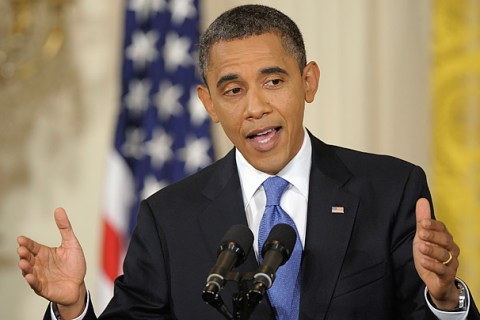
President Barack Obama speaks to reporters in the East Room of the White House in Washington, Oct. 6, 2011.
“Why?” Barack Obama asked Republicans about their opposition to his job creation bill. Then he asked it again. And again. By the time he was done, the President had repeated the question, in different ways, some 15 times.
“Why would you be opposed to tax cuts for small businesses and tax cuts for American workers?” he asked at a Thursday morning press conference in the East Room of the White House. “Why wouldn’t we want that to happen? Why would you vote against that?. . . . Why wouldn’t we want to make sure that those teachers are in the classroom teaching our kids?” He even tried declarative statements. “It is now up to all the Senators and hopefully all the members of the House to explain to their constituencies why,” he said.
This was Obama on offense. It was Professor Obama to be more exact, attacking with the Socratic method. At one point, he even gave the White House Press Corps homework. “Here’s a little homework assignment for folks. Go ask the Republicans what their jobs plan is if they’re opposed to the American Jobs Act, and have it scored — have it assessed by the same independent economists that assessed our jobs plan.”
Of course, Republicans have answered his questions already. They see further short-term stimulus, which polls favorably among the general populace, as another sugar-high quick fix, which will only harm the country down the road when taxpayers have to find a way to pay off the resulting increase in deficits. Instead, Republicans have proposed a bunch of long-term reforms—regulatory changes, mainly, trade bills and corporate tax reform– that will have little immediate impact on the American jobs crisis.
Obama knows this, of course, but he wants the American people to realize the implications: One party is pushing for immediate help to the struggling economy while the other’s focus lies beyond the immediate problem. “And what I’ve heard from Republicans is, ‘Well, we’re agreeing to do these trade bills,’” Obama said. “That’s great. I’m in favor of those trade bills and I’m glad they’re passing. But that’s not going to do enough to deal with the huge problems we have right now with respect to unemployment.”
Professor Obama has a thesis he wants to test. If his proposals poll better than the Republican proposals, he believes he can pressure Republicans to bend to his will or suffer the political consequences. “If Congress does nothing, then it’s not a matter of me running against them. I think the American people will run them out of town because they are frustrated and they know we need to do some — something big and something bold,” the President said.
Republicans, meanwhile, are betting that the next election will not be about tax policy or jobs programs or another round of stimulus. They think it will be much more basic: Did Obama solve the economy’s problems or didn’t he? “Where are the jobs?” has become Speaker John Boehner’s refrain. In other words, Republicans are hoping that the lack of a short-term stimulus will be blamed not on them, for blocking more stimulus legislation, but on President Obama for presiding over the continued malaise.
That is the big standoff, the political game of brinkmanship that will define the rest of the year, and possibly Obama’s entire re-election campaign. Both parties have staked out their positions. At some point, the American people will take sides. Professor Obama wants to explain the political dynamics behind the Republican party’s long-term vision of economic recovery. But like any great professor, he is not just going to give away the answer. He is just going to ask, Why?