

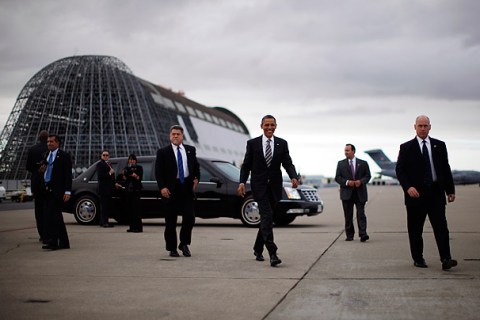
U.S. President Barack Obama, center, arrives in San Jose, California, Sept.r 25, 2011.
One big luxury of being an incumbent President is that your rival party’s primary process is likely to drive its candidates to the right, as they pander to their base. Speaking at a DNC fundraiser in San Jose, California, on Sunday night, President Obama sought to capitalize on the GOP’s primary circus with the kind of tough rhetoric we’re likely to hear more of from the embattled President.
Some of you here may be folks who actually used to be Republican, but are puzzled by what’s happened to that party. I mean, has anybody been watching the debates lately?
You’ve got a governor whose state is on fire denying climate change… You’ve got audiences cheering at the prospect of somebody dying because they don’t have health care, and booing a service member in Iraq because they’re gay. That’s not reflective of who we are. We’ve had differences in the past, but at some level we’ve always believed, you know what, that we’re not defined by our differences. We’re bound together.
This is a very satisfying line of attack for a Democratic audience. (Obama has his own base to rally, of course). But the attack isn’t without its problems. The governor Obama references here is, of course, Rick Perry, whose state is battling massive wildfires. And Perry’s preference for theology over science when it comes to the climate offers a perfect contrast to a President who first ran, in large part, promising a return to data-based pragmatism where ideology had taken hold. (Obama’s message might resonate less with members of the general public, however, many of whom doubt–despite an overwhelming scientific consensus–man-made climate change, as well as a connection between global warming and extreme weather.)
As for those “audiences”: Last week’s GOP debate audience cheered when Rick Santorum said he would re-implement the military’s “Don’t Ask Don’t Tell” policy. And a couple of people did boo after a gay soldier in Iraq posed a question, via video, about the end of DADT. Obama seemed to imply that the entire crowd booed the soldier, which, as conservatives are protesting, seems a little unfair. Likewise, it would appear that, at another debate a few days earlier, a couple of jerks endorsed a moderator’s hypothetical scenario where a sick 30-year-old who hadn’t bought insurance would be left to die. It doesn’t seem quite fair to say that the entire audience “cheered” this idea.
The bigger point here is Obama’s larger emerging theme: That the Republican candidates are pandering to–and controlled by– radical and intolerant Tea Party activists. With employment around 9% and precious little sign of recovery in sight, this may be the President’s best hope for a winning re-election message.