



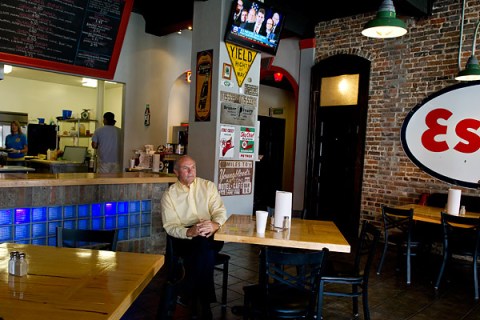
Hope Mayor Dennis Ramsey waits for a burger at Tailgaters, in Hope, Arkansas, Sept. 20, 2011.
Hope, Arkansas
Well, I’ve known the guy for about 25 years and I couldn’t just let his birthplace pass me by. The house where Bill Clinton first lived is on the main road into town and it’s been restored beautifully. It isn’t exactly overrun with visitors, but it’s a nice, quiet place filled with lots of pictures of Billy Blythe as a chubby baby. Hope is a nice quiet place, too. I had a sweet tea with the Mayor, Dennis Ramsey, who told me that the local economy was stable, as was the local population–about 10,000.
What about the housing market? I asked. A lot of foreclosures? This got Ramsey’s attention, since he’s a local banker.
“We didn’t get into the subprime market down here,” he told me. “So our market didn’t collapse the way it did in northwest Arkansas,” where the presence of a lot of Tyson’s and Walmart executives led to overbuilding. “We’re having some defaults, as you do in any recession”–the unemployment rate in Hope has doubled from 4 to 8%, he said, “but nothing we can’t handle.”
I asked the mayor how the mortgage market is now and he rolled his eyes, “If you’re a banker, you’re hoping that those people walking through the door don’t want to buy a home,” he said.
Why? I asked. “The federal paperwork has become an ordeal since Dodd-Frank [the financial regulatory reform bill] passed last year,” he said. “There’s this complicated HUD disclosure sheet that both the buyer and seller have to fill out. We got one thing wrong on one deal–it was a technical error, made zero amount of difference in the cost or terms of the mortgage–and we had to eat the the entire closing costs.”
Ramsey said that mortgage-lending had become so complicated that his bank had subcontracted out to a mortgage company, which, of course, reduces the bank’s profit. “Well, you could see how the government might want to take every precaution, given what happened in the mortgage market,” I offered. “Maybe they should have had different regulations for different-sized banks.”
“Yeah, but with the government, it’s usually one size fits all,” Ramsey said. “The same regulations apply to the big banks as apply to us, which is why you’re going to see a lot of consolidation, a lot of banks merging. It just doesn’t make as much sense to be a small rural bank these days.”
Ramsey, who describes himself as an independent, said the load of federal regulations just kept getting heavier over the years in his work for the town of Hope as well. “And it’s from both sides,” he said. “Republicans as well as Democrats.” I asked him what the Republicans had saddled him with and he said, “Bush gave us No Child Left Behind, which required a lot of paper. And his father gave us the Americans with Disabilities Act. Now, you really want to see those people taken care of, but the regulations were ridiculous. We found ourselves having to build wheelchair ramps where there weren’t any sidewalks, wheelchair ramps right onto the grass.”
As I’ve written here before, this is something Democrats–the party of government–have to take seriously. Regulations need to be form-fitted as much as possible to businesses according to size and type, not one-size-fits-all–and they have to be constantly reviewed to make sure they’re still relevant and doing the job they’re supposed to do. But governments rarely do that. They just add sedimentary layers of regulation on top of each other. This is the kind of annoyance that rarely makes the headlines, but has a major influence on the way people, especially small businesspeople, vote.
Today’s ipod-shuffle harvest:
1. Bellarossa by Eliza Gilkyson–a gorgeous song, in Spanish, by the Texas singer-songwriter.
2. Rosalita by Bruce Springsteen–My favorite Bruce, a song that struck me as something new and amazing the first time I heard it back in 1974, with its unexpected tempo changes, fun lyrics and insuperable joy in every phrase: “The record company, Rosie, just gave me a big advance!” This was one of those very few songs–like Satisfaction by the Stones–that you hear and immediately say, “OK. we are in a new place now!” It still moved me big time, bopping down I-30, this afternoon with a smile on my face.
3. Radio King by Golden Smog. Jeff Tweedy’s tribute to Elvis Presley, who was the guy who blew me away before the Stones. At some point, I’m going to write about why I think Tweedy became a major rock figure and Jay Farrar, his senior partner in Uncle Tupelo, had less success.
4. Crazy as a Loon by John Prine. He’s aged beautifully, despite some serious health problems. I love his older, scratchier voice and his lyrics are as clever as they’ve always been.
5.Don’t Get Me Started by Rodney Crowell. It is hard to write a political song that isn’t obvious, obnoxious and pedestrian. This is a very good one, though. And I wonder if my ipod somehow senses that my pal Rodney isn’t coming on this trip, and is playing more of him as a result. Makes me happy, either way.