


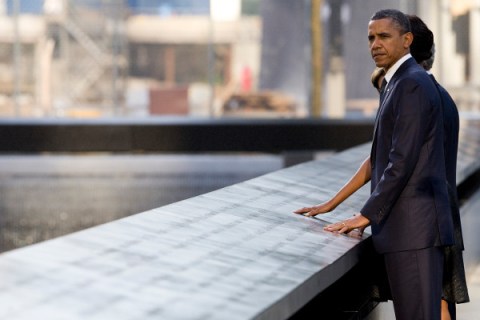
Everywhere President Obama traveled on Sunday, he was asked to remember. “Never forget,” read the signs held by a half dozen family members of 9/11 victims at Ground Zero, the words framing photocopied snapshots, or blown up portraits, of loved ones who died a decade earlier. “Forget me not,” said the young niece of firefighter who had perished, after she read her uncles name on stage.
In Shanksville, Pa., David White, the cousin of a passenger on Flight 93, asked Obama to sign his shirt, sewn with the words “Never Forget.” As Obama walked to the crash site, to stare out at the lush green field where 40 innocent people died, spotted now with yellow wildflowers, he passed a polished river stone left at the memorial that had been sandblasted with the word, “Remember.”
At these events, and during a later appearance at the Pentagon, Obama had few words of his own. He mostly just stood with his wife, Michelle, and bore witness, giving handshakes and hugs, laying a wreath, placing his hand upon the recently completed monument at Ground Zero. His words came much later, after nightfall, during a concert event at the Kennedy Center in Washington. It was here that he too asked for remembrance. But his speech did not only concern the 2,819 people who had died in the attacks of Sept. 11. He wanted the country to remember itself.
“Decades from now, Americans will visit the memorials to those who were lost on 9/11,” Obama said. “And they will know that nothing can break the will of a truly united States of America. They will remember that we have overcome slavery and Civil War, bread lines and fascism, recession and riots, Communism and, yes, terrorism. They will be reminded that we are not perfect, but our democracy is durable, and that democracy–reflecting, as it does, the imperfections of man–also gives us the opportunity to perfect our union. That is what we honor on days of national commemoration: those aspects of the American experience that are enduring, and the determination to move forward as one people.”
His choice of words—bread lines, recession—were not incidental. Obama leads a nation that could use some reminding these days. Roughly three out of four people think the country is headed in the wrong direction. Confidence in just about every national institution is at or near historic lows. The defining feature of the coming political season is a building fear among the American public that for the first time in the Post-War era, the nation’s next generation will not be better off than the last.
In many ways, it was the attacks of Sept. 11, 2001, that set the course for the current malaise. Since then, the economy, as experienced by most middle-income Americans, has stagnated. Other nations have eclipsed the United States in the pace of economic growth and the quality of investment opportunities. The national vision of America’s military might has been humbled by two protracted wars. The American Century, once an article of faith, now seems like a chapter from a history book.
It is in this space that Obama hopes to lead. In his speech Sunday night, he insisted that the glass was still half full–and filling. “These past ten years tell a story of resilience,” he said. “The Pentagon is repaired, and filled with patriots working in common purpose. Shanksville is the scene of friendships forged between residents of that town, and families who lost loved ones there. New York remains a vibrant capital of the arts and industry, fashion and commerce. Where the World Trade Center once stood, the sun glistens off a new tower that reaches toward the sky. Our people still work in skyscrapers. Our stadiums are filled with fans, and our parks full of children playing ball. Our airports hum with travel, and our buses and subways take millions where they need to go. Families sit down to Sunday dinner, and students prepare for school. This land pulses with the optimism of those who set out for distant shores, and the courage of those who died for human freedom.”
The fact that Obama finds comfort in a citizenry that still works in tall buildings, uses airplanes and plays in parks says something about the degree to which four hijacked planes interrupted the American project. But Obama’s words also spoke to something else, which has been leaking into his daily speeches in recent weeks. In addition to his quest for re-election, and his efforts to stimulate the economy again, he sees a need to raise the national spirit after so many years of false starts and frustrations. He believes the path to a better future must begin with remembering who we have been.