

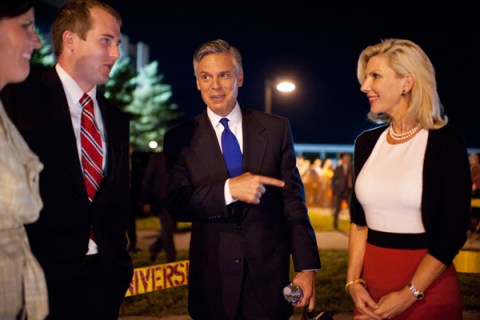
Jon Huntsman, who is running last in the latest Gallup poll and first in the magazine-profile primary, earned another encomium this week, this one from Michael Brendan Dougherty of The American Conservative. The piece does a good job of laying out Huntsman’s record, which, as the author points out, is more conservative than you might think. But its denouement underscores why Huntsman’s having such a difficult time gaining traction with conservative primary voters.
Dougherty writes that the former Utah governor has “a modest vision of politics that makes the words conservative and moderate seem fresh again—and compatible. Now it’s up to the professionals to sell that on a bumper sticker.” But conservative and moderate aren’t compatible. At least not at this stage, when a relative unknown who’s been halfway around the world for the past two years as the political world shifted on its axis is trying to introduce himself to primary voters with questions about his ties to Obama, his faith, and his policy positions that deviate from Republican dogma.
In an attempt to carve out a niche in a crowded field, Huntsman has tried to graft a moderate, truth-telling persona onto his conservative record as governor. He promised to run a positive campaign. He declined to take shots at his former boss. He’s laid out a paradigm-shifting foreign policy for a party long dominated by neocons. “To be clear. I believe in evolution and trust scientists on global warming. Call me crazy,” he tweeted, to the delight of the media. Huntsman has become, as Charles Krauthammer says, “a liberal’s idea of what a Republican ought to be,” even as he spends day after day talking up his pro-life record, his commitment to lowering taxes, his history of fiscal discipline and job growth in Utah. Huntsman has gambled that as his rivals all vie for the GOP’s right wing, the smartest play is to camp out closer to the center.
This is not a bad place to be if you’re trying to capture the coveted middle in a general election, but it’s a narrow box to put yourself in during the early stages of a primary that will be won on the right. Take, for example, Huntsman’s appearance on the PBS NewsHour yesterday, in which he says he “wouldn’t hesitate” to call on the rich to sacrifice:
[youtube=http://www.youtube.com/watch?v=huCsCsX63DM]
Huntsman clarifies that sacrifice doesn’t entail higher taxes. Most Americans agree with his assertion that the entire income spectrum should do its part to help revitalize the sagging economy, just as most Americans believe in evolution and global warming. But it’s hard to see how borrowing Barack Obama’s euphemism for new taxes helps Huntsman with conservatives nursing a suspicion that he isn’t really one of them.
The strategy of accentuating contrasts between Huntsman and his rivals has helped him get noticed, but not in a good way. Huntsman’s negatives have climbed since he jumped into the race, according to a new Associated Press-GfK poll. Amid the recent waves of press, his poll numbers have slipped. Finding the sweet spot between conservative and moderate may indeed be possible, but it requires a level of nuance that can’t fit on a bumper sticker.