

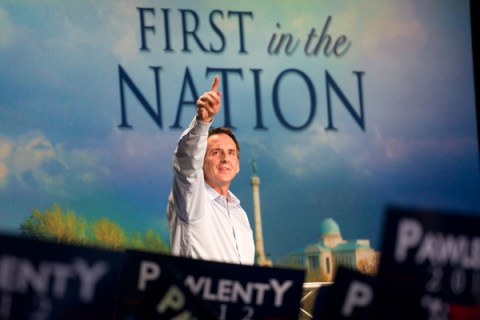
Former Minnesota Governor Tim Pawlenty dropped out of the presidential race on Sunday, citing a failure to capture momentum from Saturday’s Iowa straw poll and dim fundraising prospects. “We needed to get some lift to continue on and to have a pathway forward,” he told ABC News. “That didn’t happen.” A finalist for John McCain’s vice presidential nominee in 2008, the blue-collar conservative from a blue state was the candidate who made perfect sense on paper — executive experience, conservative record, general election promise, evangelical connections, a savvy staff — but who never ignited passion in Republican voters.
A consistent single-digit afterthought in national polls, Pawlenty’s campaign launch was forgettable and his first major debate appearance in June was a disaster. Shortly after having savaged front-runner Mitt Romney in the press over similarities between his Massachusetts’ health reform scheme and President Obama’s federal one — ObamneyCare he called it — Pawlenty was given an opportunity by the moderator at the CNN forum in New Hampshire to repeat or expand on that critique. He seemed to panic, caught up in the early-debate tradition of praising fellow candidates while attacking the sitting President, and demurred.
Pawlenty often seemed caught in a consultant trap. He had attracted some of the best Republican campaign staff in the business, even getting Nick Ayers, the young up-and-comer who had served as the youngest ever executive director of the Republican Governors Association, to run his campaign. But in working to make a splash on the national political scene, Pawlenty kept trying to be things he wasn’t: loud, flashy, combative. His campaign made summer blockbuster trailer web videos to drum up some excitement. He resorted to strong, and sometimes bizarre language, suggesting in one interview that Obama needed adult diapers to attend national security briefings.
When it became clear that Michele Bachmann had serious designs on a White House bid, Pawlenty was put in a difficult situation. Here was a congresswoman from his own state, beloved by the grassroots, who raised an incredible $13 million for her slam-dunk 2010 re-election effort, and whose only tenuous path to the presidential nomination ran straight through Iowa, the one place he stood a chance of breaking away from the pack to seriously challenge Romney. He did what he could, contrasting his eight years in the governors’ mansion to her four years of minority intransigence in Congress to anyone who would listen. But it wasn’t a compelling tale in the Tea Party era. On Thursday night, at a debate two days before the critical Ames straw poll in Iowa, Pawlenty tried to bruise Bachmann with another attack on her light legislative record, but she counter-punched hard, questioning his conservative credentials and equating him to Obama.
Saturday’s straw poll then became a contest between Pawlenty’s curriculum vitae campaign and Bachmann’s raw power and enthusiasm. It wasn’t much of a contest. Despite heavily investing in the effort, Pawlenty claimed 2,293 votes, 14% of the total and less than half Bachmann’s tally. In a Sunday morning conference call, Pawlenty told supporters his campaign was folding. “We cannot envision a path forward to victory and so therefore we made a decision to end the campaign,” he said.
Proximately, the cause of Pawlenty’s aborted bid was money. Early debate performances and straw polls standings don’t make or break a campaign. But they do indicate to donors whether a candidate is worth investing in. Pawlenty’s failure to seriously test Romney on his turf, and to defend his own from the insurgent Bachmann, led to a deficit of faith in the T-Paw experiment. To continue, his campaign could have faced serious debt.
The Republican presidential primary will largely continue as it did without Pawlenty: Romney remains the front-runner and much of the early contest will continue to determine who emerges as the most credible alternative. Bachmann is a force in Iowa, but it’s unclear if she has broad enough appeal to make a deep run. Given some time, the newest entrant, hard-charging Texas Governor Rick Perry, has the most potential to upend everything. The rest are most likely also-rans, swept aside by a base that is looking for someone who can beat Obama or show some serious panache while trying.
“What I brought forward I thought was a rational, established, credible, strong record of results, based on experience governing — a two-term governor of a blue state,” Pawlenty said Sunday morning. “But I think the audience, so to speak, was looking for something different.”