

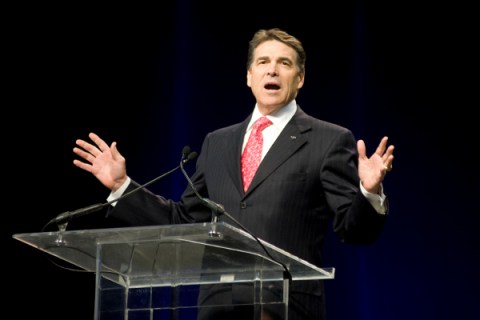
Texas Governor Rick Perry speaks to an estimated 30,000 attendees alongside at the non-denominational prayer and fasting event, The Response, held in Houston, Texas, August 6, 2011.
I always get a kick out of watching someone ignore or subvert ridiculous political traditions. So I chuckled yesterday envisioning the panic of my colleagues in the press corps desperately trying to figure out whether to cancel their Iowa reservations and book flights to South Carolina, and the curses of GOP campaign staffers who have spent the past few months trying to rustle up the right endorsements and celebrity entertainment necessary to win a blue ribbon at the Ames County Fair…er, Straw Poll.
Rick Perry had already broken a few key rules by not declaring his candidacy early enough to qualify for a spot at the straw poll this Saturday. Now he will reportedly launch his presidential campaign that very same day during an appearance in South Carolina. The nerve! And then he’ll fly straight to New Hampshire for an event just a few hours later. It’s just not done! With this counter-programming, Perry guarantees himself at least a share of Sunday morning’s headlines. And he diminishes the victory for whoever ends up winning the straw poll. How meaningful can it be, after all, if the potential new frontrunner wasn’t even there?
The timing of Perry’s announcement has already diverted political news coverage. But it’s his breaking of another rule that deserves more sustained attention.
The Response, the prayer gathering that Perry sponsored in Houston last weekend, was a fairly typical evangelical revival. It featured personal testimonies, group prayer and smaller prayer circles, and lots and lots of worship music. But it was very clearly an evangelical revival. There’s nothing wrong with a politician speaking and praying at such an event. There’s also nothing wrong with a politician calling for a day of prayer and fasting. But a politician, especially a governor who is elected to represent everyone in the large and diverse state of Texas, cannot sponsor an evangelical revival. And if he calls for a day of prayer, it cannot be limited to those “fellow Americans” who “call upon Jesus.” To do so is to break a rule in something called the Constitution.
(MORE: Four Things to Watch at Rick Perry’s Prayer Rally)
Perry and his defenders do not seem to understand or care about these distinctions. They emphasized repeatedly that the event was not “political,” as if critics were concerned that Perry would use the occasion to speak about a candidacy or question federal policies. (“I know there will be folks who think it’s something else,” Perry told Tony Perkins on his radio show. “But it’s not about me. It’s about Him.”)
Instead, religious liberty advocates including clergy from around Houston objected to Perry’s sponsorship of the revival because his position as governor is always political. Although he was introduced at The Response as simply “Rick Perry, Austin, Texas,” Perry can never set aside his official role. Again, Perry can pray to God in public. If he feels a need to ask for Christ’s forgiveness on behalf of the nation’s sins, he can do that at his church. He can attend an evangelical revival every day of the week if he wants to. But he cannot organize an evangelical Christian revival so that “as a nation” we can “call upon Jesus to guide us.”
(MORE: Sizing Up Rick Perry)
The fact that this has to be spelled out speaks volumes about our inability to discuss religion and the public square. It worsened during the Bush years, when many liberals treated any expression of religiosity by Bush as inappropriate and when conservatives dismissed as irrelevant constitutionality concerns about some aspects of the faith-based initiative.
Now comes Perry, whose remarks on Saturday contained more religiosity than Bush ever uttered publicly, and whose supporters don’t even think that church and state should be kept separate. And because of that, they interpret concerns about Perry’s use of his office to promote one religion as criticism of his faith itself. You can’t have a conversation when the response to “If the governor wants to hold a day of prayer, maybe it should be open to all faiths” is “Why are you uncomfortable letting us pray?”
Perry’s willingness to rewrite the rules of politics is already injecting some excitement into the GOP race for the presidential nomination. But his willingness to rewrite the rules of civil religion and the establishment clause of the Constitution deserves more attention.