

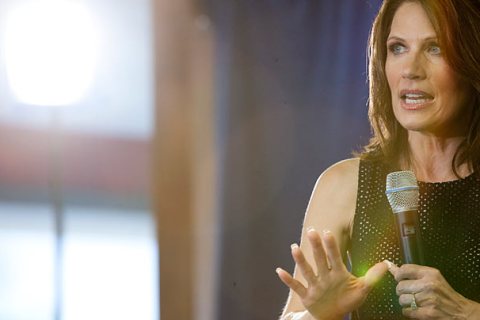
Republican presidential hopeful Michele Bachmann campaigns on July 31, 2011 in Storm Lake, IA.
It seems every week there is a story about Michele Bachmann that leads to a battle over whether said story was sexist. Her migraines. The money she spends on makeup. A mention of her being photogenic. Bachmann’s gender is not the defining feature of her campaign, but it certainly has significance—for her, her rivals and voters. Here are five reasons why.
Bachmann has more to prove: Women “have to prove their toughness and effectiveness” in a way men don’t, says Democratic strategist Celinda Lake. Because the U.S. has never had a female President, the standard is higher. This does not mean that Bachmann’s gender carries more weight than her experience, but that the glass ceiling below the Oval Office has not yet broken, despite the mighty whack Hillary Clinton gave it in 2008. “It’s somewhat unthinkable still,” says Paola Bacchetta, a professor who specializes in women’s studies at the University of California—Berkeley.
Likability vs. gravitas: Women have a thin line to tread between being seen as likable and being seen as strong. Analyzing 2010 gubernatorial elections, the Barbara Lee Family Foundation found that likability was the most important predictor of votes for female candidates. But it’s hard for a woman to endear herself to voters while maintaining a Commander-in-Chief aura, Lake says. Voters are more likely to expect a female on the presidential ballot these days, but those women are still up against many well-established female stereotypes, like being overly emotional or “flakey.”
She’s the only woman running: Being the only woman in the race, and an attractive one at that, helps distinguish Bachmann for voters. Bachmann’s gender offers respite from “the garden-variety politician,” Republican pollster Kellyanne Conway says. “So it has some inherently compelling, magnetic factor.” Bachmann is all the more effective at capitalizing on this because she doesn’t trumpet her gender as a defining quality. As Conway says, “Her gender is obvious to the eye but not operative in her presidential run.” While it would be wrong to say women will vote for candidates simply because they are women, this excitement factor may prove helpful in getting more female conservatives to the primary polls.
Other presidential hopefuls will have to tread carefully: Fellow candidate Jon Huntsman said that Bachmann makes for “good photography,” which has produced a slew of stories about whether he was dismissing her as just a pretty face. Regardless of whether he was or wasn’t, the reality is that male candidates have more minefields to avoid with a woman in the race. Offending voters is especially dangerous now because they have so many candidates to choose from. “You have to be careful in how you attack a woman, particularly in a multi-candidate race,” Lake says, “because you could consolidate women voters behind her as an underdog.”
She’s a social conservative and a woman: If Bachmann makes it to the general election, her socially conservative positions will matter all the more to female voters.“The fact that she’s a woman and espousing anti-woman positions gives her a certain kind of legitimacy to denounce it,” says Berkeley’s Bacchetta. But she could face a backlash as well. Bachmann “squelches the very agenda feminists would like to see discussed,” says Jenny Sharpe, chair of women’s studies at UCLA. This means she could energize women against her as effectively as she can rally them to her cause.
(PHOTOS: Bachmann’s life on and off the campaign trail)
Katy Steinmetz is a reporter at TIME. Find her on Twitter at @KatySteinmetz. You can also continue the discussion on TIME’s Facebook page and on Twitter at @TIME.