


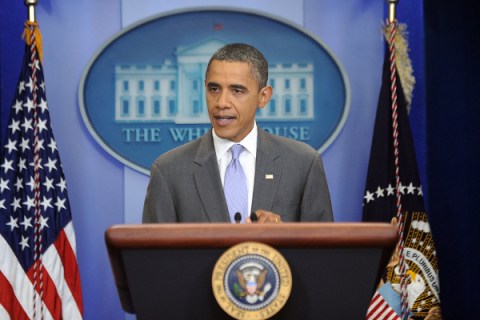
President Obama announced that a bipartisan deal to trim the federal deficit and increase borrowing authority had been reached on Sunday night, telling reporters at the White House that congressional leaders in the House and Senate had signed onto a framework that would enact $1 trillion in spending cuts over ten years and form a special commission to find an additional $1.5 trillion in savings by November, while hiking the debt ceiling through 2013 before Tuesday’s deadline.
Obama’s statement, which came just as skittish markets opened in Asia, marked the most significant breakthrough in a long weekend of frenzied negotiations and feverish partisan recriminations. “This compromise does make a serious downpayement on the deficit reduction we need,” Obama said. “It will begin to lift the cloud of debt and the cloud of uncertainty that hangs over our economy.”
The President’s confidence that the agreement would be finalized was matched by leaders in the Senate, who took to the floor just before Obama spoke to talk up the prospects of a deal. “I’m relieved to say that leaders from both parties have come together for the sake of our economy to reach a bipartisan compromise that will end this dangerous standoff,” said Democratic Majority Leader Harry Reid. “At this point, I think I can say with a high degree of confidence that there is now a framework to review that will ensure significant cuts in Washington spending,” echoed Republican Minority Leader Mitch McConnell. Both will convene meetings to discuss the agreement with their respective caucuses on Monday morning, but with both leaders on board, Senate passage seems all but assured.
The House is a different story. Just as Obama took the podium at the White House, Republican Speaker John Boehner was on a conference call with his restive members, trying to convince them that the deal was worthwhile and, at the same time, that he was not boxing them in. “The press has been filled with reports all day about an agreement,” he said. “There’s no agreement until we’ve talked to you.” One area of contention has been an enforcement mechanism that would ensure then deficit commission would actually enact its cuts. If the 12-member panel were to deadlock through November, across the board spending cuts including deep slashes to the Pentagon’s budget would automatically kick in. Social Security and Medicaid would not affected.
Getting rank-and-file defense hawks in line, let alone the large bloc of hardline conservatives, could still prove insurmountable for Boehner. But the Speaker tried to put the best face on things Sunday night, telling members that he had gone “toe-to-toe” with Obama and Reid, and won the larger argument about taxes and spending. “This isn’t the greatest deal in the world,” Boehner said. “But it shows how much we’ve changed the terms of the debate in this town.”
Obama offered similar sentiments to reassure Democrats in Congress, some of whom expressed frustration over the weekend that the President was poised to give away too much. Obama said he would continue to make a case for “balanced” deficit reduction that includes tax increases in the coming months. “Is this the deal I would have preferred? No,” Obama said. House Minority Leader Nancy Pelosi was among those with serious reservations about a deal earlier on Sunday. “We all may not support it, or none of us may be able to support it,” she said. But by the time Obama walked out in front of the cameras Sunday night, Pelosi was on board. It remains to be seen if the more liberal members of the House — and Boehner’s fiery conservatives — will follow suit.
“Ultimately, the leaders of both parties have found their way toward compromise,” Obama said at the close of his remarks. “I want to urge members of both parties to do the right thing and support this deal with your votes over the next few days.”