


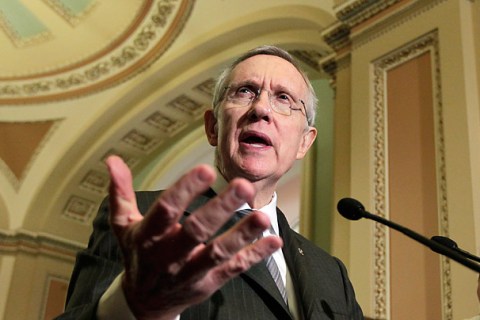
Senate Majority Leader Harry Reid speaks with reporters following the Democrats' weekly policy meeting on Capitol Hill in Washington D.C., July 19, 2011.
Updated, 6:35 p.m.
Democratic Senate Majority Leader Harry Reid ‘s office announced late Sunday that he had signed off on a deal to raise the debt ceiling and enact $2.4 trillion in budget cuts, pending agreement from his caucus. Earlier in the day, Republican Senate Minority Leader Mitch McConnell said that negotiators were “very close” to reaching an agreement “that I would feel comfortable recommending to all my members.” The 11th-hour compromise could see a Senate vote as early as Sunday night, with final passage through both chambers before Tuesday, when the U.S. would otherwise be forced to take drastic action to avoid defaulting on its credit obligations.
It’s not clear that Reid has buy-in from his caucus just yet. “There is no final agreement,” cautioned Senator Chuck Schumer of New York, the No. 3 Senate Democrat, Sunday afternoon. Democrats were unhappy with the deal negotiated between the White House and congressional Republicans, sources told TIME, after a proposal put forward by Majority Leader Harry Reid was defeated in a Senate procedural vote. A House GOP Leadership aide expressed cautious optimism, saying, “Discussions are moving in the right direction, but serious issues remain. And no agreement will be final until Members have a chance to weigh in.”
(LIST: Top 10 Congressional Showdowns)
Though the compromise package would avoid a second debt-ceiling vote early next year as Obama wanted, it calls for substantial spending cuts with no guarantee of accompanying revenue increases in return. The plan would include $900 billion in spending cuts upfront. In addition, the plan would call for a Senate vote on a constitutional balanced budget amendment, which is unlikely to pass, and the formation of a special deficit commission to find an additional $1.5 trillion in savings by Thanksgiving.
For weeks, the sticking point on the commission has been finding an enforcement measure acceptable to both parties. If another vote to raise the debt ceiling is not hanging over lawmakers’ heads, forcing action on the deficit, an equally powerful incentive will be necessary. Republicans argued — seemingly successfully — that the trigger should be an across-the-board federal haircut if the commission deadlocks. The new agreement touted by McConnell would focus those cuts on entitlements (opposed by Democrats) and Pentagon spending (opposed by Republicans). Democrats fear that Republicans will name six staunchly anti-tax members to the 12-person commission, ensuring it deadlocks and thereby forcing the cuts. They believe Republicans are more opposed to increased revenues than to defense cuts.
That said, there is increasing anger on the GOP side over those possible defense cuts. If the commission deadlocks, it could trigger $900 billion in cuts to the Pentagon’s budget over 10 years. It was fear of cutting defense in the early 1990s that led George H. W. Bush to agree to new revenue increases. This threat could again prove effective with Republicans this time, although House Speaker John Boehner is said to be pushing for fewer defense savings in the result of a deadlock.
Overall, there is a sense of disappointment among Democrats on Capitol Hill. They feel Reid had Republicans on the ropes before President Obama caved to McConnell demands. The historic deal could help Obama win reelection by denying Republicans sole ownership of the mantle of fiscal responsibility, but there may be substantial costs. Cuts to entitlements could neuter the Democrats’ argument that Republican proposals like Paul Ryan’s budget represent a partisan plot to end the popular programs. And, the latest compromise, if agreed to, is sure to anger and dispirit Obama’s progressive base.
(PHOTOS: The Best Political Pictures of the Week)
In fact, the deal is so unpopular on the left, some Democrats in Congress are wondering if it can attract enough votes to pass even if blessed by the President. If all Republicans in the Senate vote for it, they will still need 13 Democratic votes to overcome a filibuster. If Republican hawks on the other side drop off, moderate Democratic votes will be even more important. The House is an even less certain prospect. “We all may not support it, or none of us may be able to support it,” Minority Leader Nancy Pelosi said Sunday night. Liberals’ patience might be running out, but so too is the time remaining to raise debt ceiling.