


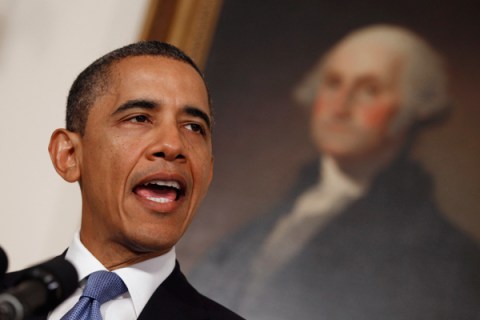
“Tweet,” said the President of the United States, Friday, speaking from the Diplomatic Reception Room. He was renewing his call, first issued in Monday’s primetime address, for Americans to contact their Senators and Congressman to demand a bipartisan compromise to the debt limit standoff.
This is what it has come to: The collapse of Speaker John Boehner’s plan in the U.S. House Thursday night has cleared the way for Congress to negotiate a plan along the lines of what President Obama has long wanted: More than $1 trillion in spending cuts, followed by a tax reform process that would raise revenues and an agreement to shave the edges off the nation’s largest entitlements.
On Friday, Obama seemed to admit that this so-called “grand bargain” would not happen before the debt limit expires. But he offered to submit one hostage for another, saying he would agree to triggers that will force Congress to cut a deal on taxes and entitlements before the next election. “If we need to put in place some kind of an enforcement mechanism to hold us all accountable for making these reforms, I’ll support that too if it’s done in a smart and balanced way,” Obama said.
(LIST: Top Ten Government Shutdowns)
This is exactly the terrain that Obama would like to be negotiating on, as his goal was always a “balanced” grand bargain. The only difference from several weeks ago is that the President is no longer in the room. He has been effectively sidelined by John Boehner, who abandoned talks with him, forcing a deal to be worked out between House and Senate leaders. That does not mean he is no longer involved. His framework is guiding Senator Harry Reid in negotiations, and depending on exact outlines of the final compromise, he will likely be involved in whipping Democratic votes.
But there is a political advantage to Obama hanging back. Any deal that appears to be too much of a political win for Obama, rather than a compromise for both sides, will be harder to attract the required number of Republican votes. The Obama brand is radioactive for most Republicans. “I actually think that anything that Barack Obama suggests is going to be opposed by the Republican establishment and most Republicans,” says Norm Ornstein, a scholar at the American Enterprise Institute. By distancing himself from final authorship, he may actually gain some policy ground.
In the meantime, Obama intends to continue to claim the centrist mantle he has for the last month, calling for “compromise,” bipartisanship and “balance.” “This is not a situation where the two parties are miles apart,” Obama said. “We are in rough agreement about how much spending can be cut responsibly as a first step toward reducing our deficit. We agree on a process where the next step is a debate in the coming months on tax reform and entitlement reform.” He continued: “The time for putting party first is over. The time for compromise on behalf of the American people is now. . . . I’m confident that common sense and cooler heads will prevail.”