

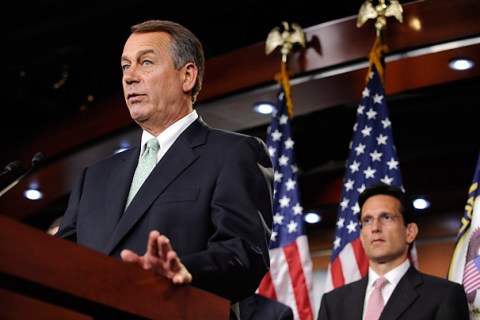
US Speaker of the House John Boehner at a news conference on the debt-limit negotiations on Capitol Hill in Washington D.C., July 15, 2011.
House Republicans passed Speaker John Boehner’s debt bill 218-210 on Friday, eking out little more than a symbolic victory in the heated debt-ceiling debate by sending the measure to the Democratic Senate, where it was hastily tabled in a 59-41 vote. Friday night’s are a precursor to a frenzied weekend of negotiations in Washington as the U.S. slides toward the brink of a potential financial catastrophe. Boehner’s measure, heralded by Republicans as a bipartisan solution to the looming debt crisis, earned zero Democratic votes. Twenty-two Republicans voted against the legislation, including presidential candidates Ron Paul and Michele Bachmann as well as 11 members of the fiery freshman class, who said it didn’t do enough to stem the tide of federal red ink even after Boehner and his deputies tweaked the measure to include an additional balanced-budget amendment requirement.
After days of wrangling, the intraparty standoff ended not with a bang, but with a whimper. There was little celebration when the gavel closed the tight vote, during which Republican Whip Kevin McCarthy stalked the floor, occasionally collaring members yet to vote. The deep division between Democrats and Republicans was on full display in the speeches leading up to the vote. In remarks to close debate on the bill, Boehner angrily blasted Democrats for failing to put forth a plan. “I have worked with the President and the administration from the beginning of this year to avoid being in this spot. I have offered ideas. I have negotiated,” Boehner said, his voice bristling with frustration. “I stuck my neck out a mile to try to get an agreement with the President of the United States.”
In response, Democrats hissed at the Speaker, who had twisted arms furiously on Thursday but was unable to secure enough votes for the bill, forcing an overnight delay on the final vote. While House minority Nancy Pelosi was powerless to stop a bill once Boehner and his deputies finagled enough votes, the Democratic-controlled Senate moved quickly to put it aside just two hours after it cleared the House. As lawmakers head into a final weekend of political combat on the debt ceiling, the upper chamber is now the lone arena for negotiations between Democrats and Republicans.
Updated, 8:38 p.m.