

There are serious financial and economic dangers in the game of chicken Congress and the President are playing over raising the debt limit, but downgrades by the ratings agencies are not among them. Sure, it sounds ominous: If Republicans and Democrats can’t agree on a deal for at least $4 trillion in deficit reduction over ten years, Standard and Poor’s says, there’s a 50-50 chance they’ll take America’s AAA rating down to AA+.
But in the muddle of conflicting plans and partisan recriminations, the President and Democrats are conflating two different threats for political purposes: the downgrade by Standard and Poor’s that might follow a short-term debt deal, and a default that would come if Congress fails to get any deal. The latter would be truly disastrous: if the U.S. failed to pay any of its obligations—at home or abroad—not only Standard and Poor’s, but Moody’s and Fitch would also declare the U.S. in default, dropping them not just a notch but all the way to Selective Default. Markets would drive up interest rates on everything from home loans to interbank lending and a double dip recession could ensue.
But Standard and Poor’s judgment about the significance of a short-term deal to raise the debt ceiling is different. First, ratings agencies don’t exactly drive markets the way they once did, thanks to their lackluster performance in the run up to the 2008 crash. Second, S&P is an outlier among the top three ratings agencies: Moody’s and Fitch say they won’t even consider a downgrade unless there’s a danger of an actual default. Third, S&P’s rating’s downgrade threat is based on a judgment about politics in Washington and the likelihood of Congress to manage its finances down the road. S&P may know a lot about businesses, especially businesses whose proprietary accounting they get access to in order to provide their impartial ratings of company’s bonds. But S&P doesn’t know a lot about politics—certainly not more than your average connected lobbyist–and they’re making their judgment based on the same public information available to everyone else.
The markets already know that, and while they are very scared of a default (which everyone including S&P still says is highly unlikely) they are not very troubled by the prospect of an S&P downgrade. “A downgrade by the ratings agencies isn’t going to tell investors anything we don’t already know,” says Reagan’s Counsel of Economic Advisors chief and Harvard professor Martin Feldstein. In fact, even S&P says the effect of its downgrade, absent default, would be minimal. In a follow-on report to it’s downgrade threat, S&P somewhat sheepishly said that while default would be a disaster, the impact (rated low, moderate or high) of a downgrade would likely not affect much:
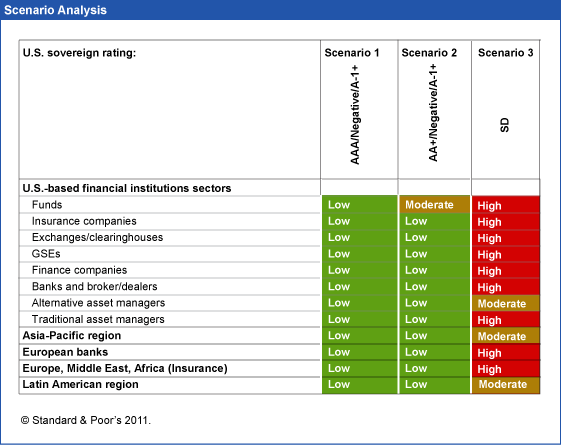
So why all the hoopla about a downgrade? There are political concerns, maybe, for Obama if the U.S. gets downgraded, though why it would fall on him and not the GOP is not clear to me. The more obvious reason is that it helps Democrats pressure the GOP for a deal that gets past the 2012 election, which has been an overriding political concern for the administration from the start. “When [S&P has] issued that kind of a warning, we’ve said that’s helpful,” one senior administration official told me, “Because they help us push for the broader deal.” Likewise those in the media who buy into the downgrade threat help the administration’s cause.
None of which should divert attention from the real danger in the game now being played in Washington: default. If Aug. 2 comes and goes without a rise in the debt ceiling, the U.S. may still be able to continue paying its bills for a little while. The debt ceiling prevents issuance of new debt, but allows refinancing of existing debt. On Aug. 4, $87 billion in T-Bills come due. The U.S. can sell in advance other T-bills that go into effect just as the Aug. 4 ones expire, and it plans to do so on Aug. 2–hence the deadline. It seems likely the U.S. will be able to flip that debt: given uncertainty in Europe and the Middle East, and especially at a time of low interest rates, even the slightest uptick in the rates necessary to move that paper should draw safe-haven investors.
Until it doesn’t. If it appears the U.S. might stop paying full Medicare benefits, or soldiers’ pay or — God forbid — its interest or principal payments, the markets aren’t going to be waiting for S&P or Moody’s or Fitch to say something about it. They’ll know Washington is broken. At that point, the animal spirits, as Keynes called them, turn and stampede and the effect would likely be bad and irreversible. But it would be the result of imminent default, not a downgrade.