

Let us pause a moment, as the debt ceiling negotiations round the final corner, to note where the various parties find themselves. House Republicans are losing sleep over the prospect of voting for something that raise tax revenue and get them primary opponents next year. House and Senate Democrats fear that President Obama will take away their election year cudgel by agreeing to do what they always say Republicans will do: Cut medicare.
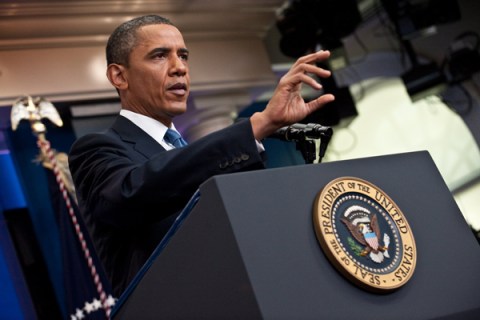
And President Obama. . . well, he is just where he wants to be: Caught between two partisan fringes, not worried about next year’s election, but rather focused on doing the hard work that career politicians refuse to do: Solving the problems of the American People. Or at least that’s what he would like you to think. In fact, he is perfectly positioning himself for his own reelection. Obama lays out his case–again–in USA Today on Friday morning, calling for a “balanced approach” between left and right: “This debate offers the chance to put our economy on stronger footing, restore a sense of fairness in our country, and secure a better future for our children. I want to seize that opportunity, and ask Americans of both parties and no party to join me in that effort.”
What he doesn’t say is that the same dynamics that will hurt members of both political parties if they vote for a compromise deal are likely to help him. That’s because what’s needed to win a presidential election these days is almost antithetical to what most members of the House (and to a lesser extent, the Senate) have to worry about. Presidential elections are won by turning out people who don’t pay much attention to politics and winning independents in purple states, like Ohio. Independent and unengaged voters can, for the most part, care less about tax pledges or long-term entitlement reforms. They just want the country to work, and they want their own lives to get better.
By contrast, congressional elections are won increasingly by holding off primary or third-party challenges, especially for Republicans. Most districts are so safely drawn, that the only real danger is losing your political base. So while presidential candidates always move to the middle–George W. Bush was a “compassionate conservative,” Bill Clinton was a “New Democrat,” Obama looked beyond red and blue America–Congressional candidates have to worry about their flanks.
In practice, Republicans do this by attacking Democrats for big government, high spending and higher taxes. Democrats do this by attacking Republicans for wanting to gut entitlements. Neither side has much incentive to give up these issues. But a compromise is a clear win for Obama. Which means that while he may not be as politically courageous as he likes to appear, he is on the cusp of a major victory. All he has to do is close the deal.