

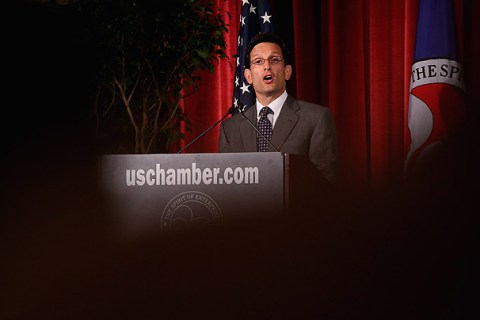
House Majority Leader and House Budget Committee Chair Rep. Eric Cantor speaks at a U.S. Chamber of Commerce event entitled Controlling Costs: The Price of Good Health July 12, 2011 in Washington, DC.
A day after a testy exchange between Barack Obama and Eric Cantor capped debt-limit negotiations at the White House, Democrats launched a coordinated attack against the House Majority Leader, portraying him as a primary obstacle to ongoing effort to reach a deal to raise the U.S.’s borrowing authority by the August 2 deadline.
“Eric Cantor has shown he shouldn’t be at the table, and Republicans agree he shouldn’t be at the table,” Senate Majority Leader Harry Reid said on Thursday morning in a withering speech that called Cantor “childish” and suggested his hard-line haggling was a ploy to solidify his political capital with the House GOP’s Tea Party wing. Speaking on the Senate floor, Reid cited a Politico report that quoted an unnamed Republican saying Cantor was adopting a posture designed to further his personal ambitions. “He’s all about Eric,” the lawmaker reportedly said.
Of the group of negotiators meeting daily to hammer out a debt-ceiling deal, “there’s really only one person who has not made any concessions,” Democratic Senator Chuck Schumer said at a press conference in the Capitol. “It can’t just be Eric Cantor deciding everything. If Eric Cantor decides everything, I fear we’ll be in default.”
And in a separate press conference, House Minority Leader Nancy Pelosi, in a light, weary tone that suggested the negotiations had devolved into a farce, praised Obama for bearing with Republicans. “The President has more patience than Job,” Pelosi said, brandishing a penny as a theatrical nod to Republicans’ refusal to consider even a scintilla of new taxes. Without mentioning him by name, Pelosi tore into Cantor for claiming the President left Wednesday night’s meeting in a huff, saying Cantor failed to grasp Oval Office protocol. “That’s how meetings with Presidents end,��� Pelosi said. “You don’t leave first. The President leaves first. So that was completely appropriate, unless somebody in the room thought that he or she should have the last word.”
While they lambasted Cantor, Democrats heaped praise on other Republican negotiators, including House Speaker John Boehner, who supported a sweeping bargain that would lop some $4 trillion from the federal deficit and overhaul the tax code, and Senate Minority Leader Mitch McConnell, who floated a proposal that would give Obama the authority to raise the debt limit in three increments while Congress casts corresponding protest votes against the hikes. By training the spotlight on Cantor, Democrats are hoping to open fissures between Boehner and Cantor, as well as create a juxtaposition — the pragmatic President and the intractable Tea Party proxy — that they believe will resonate with the public.
At a press conference to tout their balanced-budget amendment scheduled to hit the floor next week, Republican leaders played up the buddy-buddy bonhomie, in a wink at the proliferation of reports suggesting a frost behind the scenes. “The Speaker and I have consistently been on the same page,” Cantor said. In a camera-friendly photo-op, Boehner joined Cantor at the podium, hooking an arm around his lieutenant to stress the strength of their partnership. “Any suggestion that the role that Eric has played in these meetings has been anything less than helpful is just wrong. We’re in the foxhole,” Boehner said. “I’m glad Eric’s there.”
Cantor’s aides say Democrats are painting a caricature that belies the significant concessions Cantor has made during the nine weeks he’s been engaged in high-level talks, first in the Biden-led negotiations — which Cantor left after a row over tax increases — and now at Obama’s daily confabs. “At the beginning of the Biden talks, both sides made the decision to focus on areas of commonality instead of areas where there were no agreements, such as repealing ObamaCare for the Democrats and raising taxes for the Republicans. In that context, Leader Cantor and the other participants identified more than $2 trillion in spending cuts that were on the table for both parties,” Cantor spokeswoman Laena Fallon said in a statement to TIME. “In the spirit of compromise, those cuts weren’t exactly what either side would pick.”
Without a clear path to find the $2.4 trillion in spending cuts that would meet Republicans’ dollar-for-dollar ultimatum, Democrats may be hoping that battering Cantor will force Republicans leery of the damage a default would inflict to put a different leader at the helm of the negotiations. It’s unclear whether the strategy will work. Several House Republican aides say that the conference remains unified in its three ironclad demands for the deal: no new taxes, spending cuts commensurate with the increase in the debt-limit, and caps and controls on future spending. Rumors of a leadership rift, they say, are overblown, even if more moderate members have grumbled about Cantor’s approach. “Anytime Boehner or Cantor and the President get into a tussle, it hardens our resolve,” says a House GOP aide.
Nor have some members appreciated the barbs Democrats have hurled at Cantor. Asked about Democrats’ potshots, GOP Representative Allen West told TIME, “I could sit here and say the President was pretty much a petulant, immature child as well.”
Tea Party freshmen like West don’t have a seat at the bargaining table. But they do have a presence in the room. Cantor has said his insistence on a revenue-neutral deal reflects the will of his members. By dangling their reluctance to strike a deal, Cantor can try to force Democrats to capitulate rather than usher in the chain of grim consequences that would accompany default. “There is a dose of pragmatism in all that we do,” he said Thursday afternoon. “We are not yet at 218,” the narrowest majority in the House of Representatives.
For their part, Democrats question whether Cantor is defining reality or creating one that aligns with his own goals. “He’s trying to make the reality that some packages can’t pass the House,” Schumer said. “He’s not just representing it, he’s making it.” But Republican aides say he and Boehner are “sincere” about their whip count.
A Democratic source said Cantor was silent at Thursday’s negotiating session, at which Obama told Congressional leaders that he expects them to pinpoint a path forward over the next 24 to 36 hours, according to a Republican aide familiar with the substance of the meeting. If they’re unable to do so, the President suggested another meeting could be called over the weekend, during which time Obama and his staff would be “on call,” the GOP aide said.
By that time, the group may have moved to a back-up plan. A model based on McConnell’s framework is one possibility, and Boehner said Thursday that measure is “worth keeping on the table.” Republicans will meet Friday morning to discuss their options. Both Boehner and Pelosi have pushed back on rumors that Obama would shift the talks over the weekend to the presidential retreat at Camp David in hopes that a change of scenery might help break the impasse. It’s unlikely that the partisan deadlock would simply crumble in the Maryland mountains, but something has to break the logjam. Lawmakers are running out of time.
With reporting by Zachary Cohen
Alex Altman is a Washington correspondent for TIME. Find him on Twitter at @aaltman82. You can also continue the discussion on TIME‘s Facebook page and on Twitter at @TIME.