

Jared Bernstein, the liberal former economist for Vice President Joe Biden, posted this chart Wednesday morning, which helps to frame the current debate over shared sacrifice in deficit reduction. To explain the current fiscal mess the country now finds itself facing, one must look at both lines.
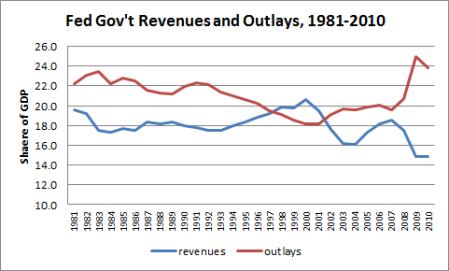
But then to listen to House Republicans, the significant drop in tax income over the last few years to historically low levels has nothing to do with the current fiscal mess. As Speaker John Boehner likes to say, “Washington doesn’t have a revenue problem, it has a spending problem.”
This is the statement of an activist, bent on changing the status quo that America has enjoyed for most of the last century, including the era of Ronald Reagan. It is not the statement of a realist primarily focused on returning to the fiscal discipline of the 1990s. Martin Wolf, in the Financial Times, makes this same point:
The astonishing feature of the federal fiscal position is that revenues are forecast to be a mere 14.4 per cent of GDP in 2011, far below their postwar average of close to 18 per cent. Individual income tax is forecast to be a mere 6.3 per cent of GDP in 2011. This non-American cannot understand what the fuss is about: in 1988, at the end of Ronald Reagan’s term, receipts were 18.2 per cent of GDP. Tax revenue has to rise substantially if the deficit is to close.
What Wolf does not understand is that the genius of Grover Norquist’s tax pledge, which now binds House Republicans, is that it seeks a radical change while sounding eminently reasonable. “Sure,” voters say, “don’t raise my taxes. I like that idea.” But what they are really saying is, “Sure, undo the post-war welfare state, including Medicare and Social Security.” Norquist always hoped to force the sort of legislative deadlock we now face in the hopes of weakening the post-war entitlements far beyond anything Newt Gingrich or Ronald Reagan ever attempted. Historically, fiscal policy in the U.S. moves in both directions. Taxes are cut to spur growth, or in times of plenty, as they were in 2001 and 2003, and they are raised when tax receipts crater during economic slowdowns as they were in 1991 and 1993.
What Wolf does not understand is that Norquist was deadly serious when he joked, “I don’t want to abolish government. I simply want to reduce it to the size where I can drag it into the bathroom and drown it in the bathtub.” And now Norquist just might succeed in getting the whole country to come along for the ride.