

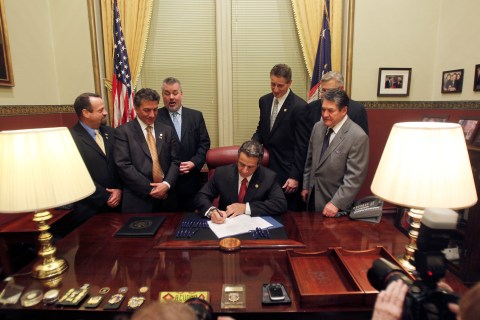
New York Governor Andrew Cuomo signs a bill legalizing same-sex marriage in New York on June 24, 2011.
The battle to bring marriage equality to New York was fought by some unlikely heroes. The bill’s champion, Democratic Governor Andrew Cuomo, didn’t support gay marriage until 2006, long after predecessors from his party. Ken Mehlman, the Republican strategist who engineered George W. Bush’s re-election in part by campaigning on a constitutional ban on gay marriage–and then came out as a gay man himself–helped marshal support among recalcitrant factions in Albany. Much of the money was ponied up by a cadre of conservative financiers. And then there were the four Republican state senators who bucked their party to nudge the bill over the line, 33 to 29.
The decisive 32nd vote was cast by Republican Stephen Saland, a Poughkeepsie lawyer first elected to the state legislature in 1980. In an interview with TIME — his first with a national publication since his decision to support the bill, thus ensuring its passage — Saland recounted the process of deliberation that culminated in a historic vote. “At one time I thought civil unions afforded the opportunity to provide the ability for same sex couples to attain the status they wanted,” says Saland, who voted against same-sex marriage when a similar bill was defeated in 2009. “When I came to the conclusion that civil unions wouldn’t do it, and if you really believed in fairness and equality and doing the right thing…for me there was only one answer,” Saland says. “It was purely a vote of conscience. I did what I thought was the right thing.”
His thought process evolved through research, discussions with “many, many people on both sides of the issue,” and talks with his wife and children. “I wasn’t surprised by my wife’s support and advocacy for same-sex marriage,” he says. He was, however, struck by a question posed by his kids. “What surprised me was that all of my children, a couple of whom are more conservative than I am, basically said, ‘Why do you have a problem with supporting gay marriage?'” he recalls.
Much of his concern stemmed from questions surrounding so-called religious exemptions — in essence, the right of religious institutions and affiliated groups to refuse to allow their facilities to be used for same-sex weddings. At the behest of Republican Senate leader Dean Skelos, Saland, who is Jewish, and two other fence-sitting colleagues met multiple times with Cuomo in the weeks leading up to the vote to craft the language for an amendment that safeguarded institutions from penalties if they opted on religious grounds not to provide services for same-sex marriage. They also haggled over related issues, such as the so-called “inseverability clause,” which torpedoes the entire bill if any component is invalidated — a measure Republicans say protects religious groups from legal challenges.
Saland was under intense lobbying pressure from both sides. That included patient prodding from Cuomo, with whom — in addition to group sessions — he met with privately in the governor’s second-floor office in the state capitol. “The meetings were professional, productive. There were no histrionics,” Saland says. “[Cuomo] was deeply immersed in working out the details. At the same time, he was deeply sensitive to our concerns and about religious freedoms.”
Saland made up his mind to vote for the bill about a week before the June 24 vote. Even then, he refused to comment publicly on his position, as he waiting for the language of the amendment to be finalized. Once it was hashed out, he told Cuomo, during a private meeting in the governor’s office, that he was willing to become the 32nd vote, the one that would safeguard marriage rights for a state of some 19 million people. “It was probably the most difficult vote I’ve ever taken,” Saland says. Well before he cast it, he knew the repercussions that would follow — rebukes from constituents and loyal interest groups, threats of an electoral comeuppance from gay-marriage opponents. “I’m hearing it from both sides,” he says. “I’m either being lauded as a hero or condemned as a demon, and I’m prepared for whatever the consequences may be.”
And yet, despite the difficulty of his internal deliberations and the anguish that attended them, Saland seems to have a quiet conviction that his vote places him on the right side of history. “One of my children said to me, stop being the anti-hero [by staying silent],” he explains. “To the extent that you can let my grandchildren know that I was involved, please do that.”
Alex Altman is a Washington correspondent at TIME. Find him on Twitter at @aaltman82. You can also continue the discussion on TIME’s Facebook page and on Twitter at @TIME.