

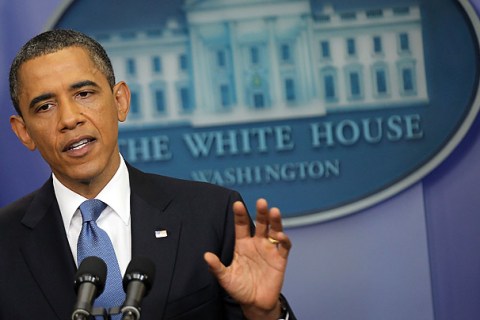
U.S. President Barack Obama holds a news conference at the Brady Press Briefing Room at the White House July 11, 2011 in Washington, DC.
At a press conference on Monday, President Obama rebuffed congressional leaders for their recalcitrance to make concessions in the ongoing debt ceiling negotiations, and continued to make his case for an ambitious, all-inclusive deficit reduction deal. But with chances for a grand bargain already nixed by House Republicans, Obama’s appearance seemed more about pressing his tactical political advantage than furthering negotiations.
He littered his remarks with reminders that he is the responsible and concerned steward of talks: “I’m prepared to take on significant heat from my party to get something done,” he said. “I have bent over backwards to work with Republicans,” he later added.
And, of course, he scolded stubborn members of Congress for not wanting to “eat [their] peas.” “This is the United States of America. We don’t manage our affairs in three-month increments,” he said, restating his pledge not to sign any temporary extension of the federal borrowing limit.
There were also theatrical gestures of good will. He lauded Boehner as “very sincere” in his desire for a comprehensive deal, and “a good man who wants to do right by the country.” Of course, such praise does Boehner few favors with his caucus, many of whom already feel Boehner stretched their will in signaling an openness to tax increases.
He even worked in an argument about economic certainty, long a GOP talking point scoffed at by Democrats, insisting that deficit reduction — and in conjunction, raising the debt ceiling — was all about brightening the abysmal employment outlook. “The public isn’t worried about the ins and outs of a Treasury auction,” he said. “They’re worried about their jobs.”
When House Speaker John Boehner, his hand forced by members of his own party, abandoned a grand bargain on Saturday night, he left Obama in a politically favorable position. Obama can now credibly claim he is willing to make the most drastic concessions in exchange for minor revenue increases that the GOP has proven unwilling to budge on. That will blunt future critiques from Republican presidential candidates about his supposed thirst for big government. And it also insulates him from some of the fallout if a deal fails, or turns out to be underwhelming in scope. The point of Monday’s press conference, it seems, was to make sure everyone who watched was acutely aware of that dynamic.