


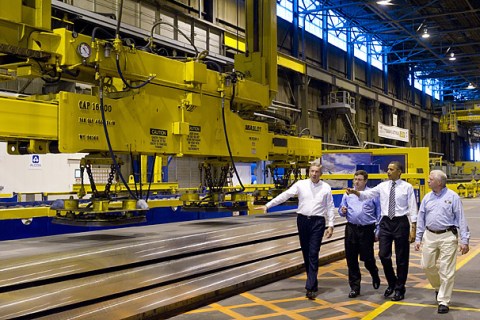
US President Barack Obama tours Alcoa Davenport Works Factory prior to speaking on the economy in Bettendorf, Iowa, June 28, 2011.
Stanley Greenberg, the Democratic pollster who helped elect President Bill Clinton, South Africa’s Nelson Mandela and Israel’s Ehud Barak, says all of his clients have had the same, sometimes terrible, instinct: “They want to prove that their economic policies have worked.”
In times of plenty, that gut feeling is right. The nation cheered the gangbusters growth under Ronald Reagan in 1984, and the mid-1990s Clinton economic boom. But when the economy is sour, politicians who litigate the past risk sounding tone-deaf to the troubles of the present. This is why Greenberg is now speaking up. He fears President Obama may make a huge mistake by trying to convince voters he saved the economy from a much worse fate. “No one is going to give you much credit for what you have done for this recovery,” says Greenberg, who has been testing messages in focus groups and polls for Democrats to use in the coming election. “Saying the economy is starting to make progress is bad.”
President Obama’s own strategists agree — but only in part. New projections of tepid economic growth under 3%, and unemployment over 8.5%, have all but erased hopes that Obama can run for reelection as the guy who saved America from the worst economic crises since the Great Depression. It’s not a convincing message when four out of five Americans still rate the economy as “poor.” So Obama has shifted to a message of “winning the future,” touting an “innovation” agenda. “The question is who has the vision to move the country forward,” says Daniel Pfeiffer, the White House communications director.
(PHOTOS: Behind the Scenes of Obama’s Campaign)
But behind the scenes, there is a fierce debate in Democratic circles about just how much Obama should also be focused on explaining the recent past. As it now stands, the President’s stump speech features a backward-looking message at its core. Obama trumpets “more than 2 million jobs in the private sector” that have been created in the last 15 months. At a recent speech in Ohio he dismissed May’s bad jobs numbers as “bumps on the road to recovery.” In Greenberg’s estimation, this is an error on par with President Obama’s midterm election pitch, which described the nation as a car that had just gotten out of a ditch that Republicans drove into in the first place. The metaphor didn’t work, Greenberg explained in a recent memo, because “people thought they were still in the ditch.”
Those close to Obama say Greenberg is drawing the wrong conclusions. “Nobody is hanging a mission accomplished sign on the economy,” shoots back David Axelrod, the President’s top message adviser who is now working on the reelection campaign. “Stan seems to feel that you can run for President and be President without putting things in context in any way.” Axelrod has argued that a forward-looking message needs to include clear mentions of both the current successes of the President and the Republican approach that Obama believes helped create the current situation. Geoffrey Garin, a pollster for Senate Democrats who has recently conducted focus groups for Priorities USA, a new independent expenditure group that plans to support Obama in 2012, agrees. “‘Recovery’ is not the right word,” Garin says. “But it is important to talk about the progress that is being made and the foundation that is being made for more progress.”
(PHOTOS: Obama’s First Two Years: An Inside View)
Implicit in Greenberg’s theory is a mea culpa of sorts, an admission that he misunderstood the public mood in early 2010, when he felt the President’s fortunes would be helped by modest economic improvement. “I still thought that the economy was going to kick in,” he said.
But after polling and holding focus groups, Greenberg came to realize that the real concern over the economy dates further than the 2008 collapse, to an entire decade of economic stagnation for the middle class. Recovery from the financial crisis, even if it were happening faster, would not be enough. When Greenberg tested messages trumpeting the recent rebound, or blaming the economy on Republican mismanagement before 2008, the results were dismal, he says. Voters did not want to hear it. They responded more positively to messages about long-term fixes, like rebuilding the middle class and taking on China, or moving beyond the politics of blame.
(More: Obama Bound on the Economy)
Just how to calibrate that message will be a key early test for the Obama campaign. Obama has already offered several formulations, calling for “nation building here at home” in a recent primetime address on Afghanistan, and arguing that the Republicans spending plans amount to a “vision of our future that’s deeply pessimistic.” Obama strategists have already set their sights on the final months of the campaign, when they hope to make the election a choice between Obama and his Republican challenger, not a referendum on the last three years.
Republicans, meanwhile, are focused squarely on Obama’s job creation record. “The President has failed” has become GOP frontrunner Mitt Romney’s refrain. But Greenberg argues that such a strategy could backfire just as well on Romney. “If they make the election about ‘Did we get the stimulus right?,’ and we make the election about how to create jobs, we win that,” Greenberg argues. “That could be a trap for them.”
(More: For More Stimulus, Obama Has a Tough Sell and a Narrow Window)