

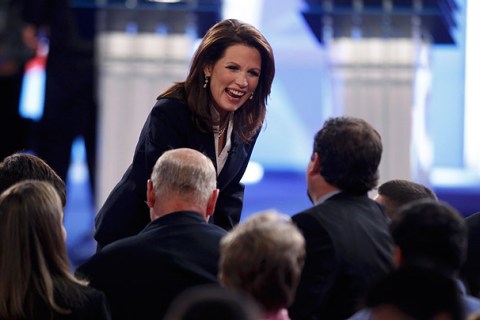
U.S. Rep. Michelle Bachmann, talks to the audience after the first New Hampshire debate of the 2012 campaign at St. Anselms College in Manchester, New Hampshire June 13, 2011.
In three congressional terms, presidential contender Michele Bachmann has made a name for herself as a formidable fundraiser. As of her latest filing with the Federal Election Commission, Bachmann had $2.8 million cash on hand (compared with, say, veteran Ron Paul’s $1.6 million). And she took in $13.5 million in the 2010 election cycle, out-raising the leader of her own party, John Boehner, by almost $4 million and making Bachmann the most prolific fundraiser in the House. So how is she getting all that money?
Bachmann is increasingly getting money from individuals making smallish donations, a feat that helps solidify her status as a grass-roots, Tea Party–fueled outsider rather than another Establishment fixture. Of the $1.7 million she reported raising last quarter, only $1,500 came from non-individuals, and the average donation was just $619.34. But Bachmann didn’t always eschew Political Action Committee money. The Minnesota Congresswoman has upped her individual contributions from a little more than half of her total funds, to nearly 100%, as seen in the illustration below.
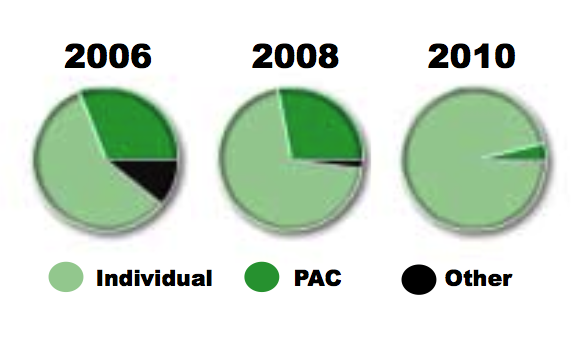
Source: OpenSecrets.org / By the author
The list of past committee donors includes a range of industries and interests, from health care company Aetna to oil giant ConocoPhillips, Koch Industries, Big Pharma’s Pfizer and the Republican Jewish Coalition. KochPAC donated to Bachmann sporadically from 2006 to 2010, and is affiliated with the company run by the billionaire Koch brothers, David and Charles, whose myriad foundations and advocacy organizations promote libertarian and Tea Party causes. Bachmann has also received money from committees associated with other big names: Mitt Romney, Sarah Palin, Darrell Issa and Boehner.
Bachmann’s penchant for making incendiary statements — “President Obama is a one-term President!” is a recent favorite — and the donations they can inspire was the subject of a June 19 Washington Post article. It dubbed the statements “money blurts,” a grass-roots tool that Bachmann wields well. And even though she has shifted her focus to individual donors, she can always go back to courting major committee donors; candidates who rely on PACs can expect to bring in average donations closer to the $5,000 range.
Bachmann’s solid fundraising skills are one more reason to think that she could be a force in the 2012 presidential campaign. Like past insurgent candidates, the Iowa caucuses offer Bachmann a good chance to steal the show. “I think she’s got a wide-open field in Iowa. And she could score there. I would put disproportionate resources and efforts into Iowa,” veteran GOP strategist Roger Stone recently told TIME. The Hawkeye State is a test of activist enthusiasm, and Bachmann shares the populist appeal of former winners like Mike Huckabee. But candidates also spend a lot of money busing in supporters and paying voter fees to try to sway results there. And the contests beyond Iowa, where Huckabee failed and where Romney’s fundraising juggernaut awaits, will require real campaign cash. Bachmann is the rare outsider candidate with the chops to bring it in.