

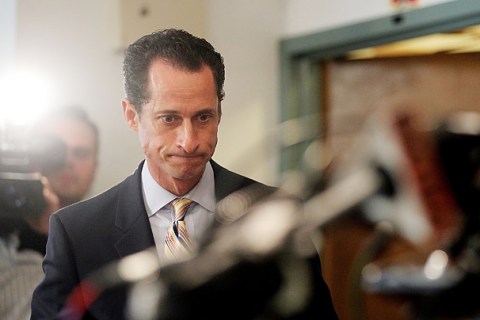
Rep. Anthony Weiner announces his resignation June 16, 2011 in the Brooklyn borough of New York City.
The Anthony Weiner scandal ended in much of the same way it began. Hecklers hijacked the New York congressman’s Thursday afternoon press conference in New York City, rudely interrupting a somber resignation announcement with obscene missives and questions about genital girth. Dignity, on both sides, was in short supply.
With new revelations about Weiner’s sexual explicit online exchanges with numerous women emerging almost daily and Democrats scrambling to sever ties, the seven-term representative finally called it quits. “Today I am announcing my resignation from Congress,” he said over the din of clicking cameras and screeching radio clowns. “Now I’ll be looking for other ways to contribute my talents.”
Weiner’s supposed talents are what got him in trouble in the first place. Noted for his media savvy and cable-friendly partisan bombast, the once-promising politician wrecked his career with careless social-media flirting. As the scandal unfolded and Weiner clung to his seat, his colleagues in Congress were slow to support him in his first week of prevaricating defiance, and quick to abandon him when the worst allegations surfaced. That was the price of Weiner’s ambition, abrasive style and aggressive media courtship: in the end, he was left with few friends.
Once thought to be the front-runner for New York City’s 2013 mayoral contest, Weiner’s resignation has immediate political implications. The field of candidates to succeed Mike Bloomberg is now wide open. Governor Andrew Cuomo will schedule a special election to replace Weiner, the third member of the New York Delegation unseated in the wake of a sex scandal–Chris “The Craigslist Congressman” Lee and Eric “The Snorkler” Massa both resigned after reports of embarrassing behavior came to light–in the past two years.
Weiner could attempt a political comeback sometime in the future. But he seems best suited to follow in the footsteps of another disgraced Empire State officeholder: Former Governor Eliot Spitzer, whose rehabilitation from the prostitution scandal that ended his career has largely occurred on cable TV. Weiner may have been the first national political figure undone by social media, but his penchant for melodrama better lends itself to Spitzer’s medium.
If anything, Thursday’s circus was further proof that even in disgrace, Weiner just can’t quit the cameras. He could have sent out a statement quietly announcing his resignation. He didn’t take questions or engage in the excruciating ritual in which a shamed politician’s wife joins him on stage to bear witness to supposedly redemptive seppuku. Weiner willfully put himself back in the spotlight for one more round of public humiliation. If he’s to follow in Spitzer’s path, it won’t be the last time.
How Anthony Weiner got burned by Twitter.